Before the gloves go on: How glove retrieval influences cross-contamination

Infection prevention in dentistry traditionally centers around hand hygiene, sterilization, surface disinfection, and the proper use of personal protective equipment (PPE). However, one aspect of operatory asepsis that receives far less attention is the glove dispensing process itself. While examination gloves are intended to provide a clean barrier between clinician and patient, contamination risks may begin before the gloves are ever donned.
Transfer of bacteria
Dental operatories are high-touch environments characterized by aerosol generation, rapid patient turnover, and continuous interaction with clinical surfaces. Although gloves are manufactured under controlled conditions, studies have shown that contamination can occur during glove retrieval and handling within the operatory.
Traditional glove boxes often require clinicians to grasp multiple gloves before selecting one increasing the likelihood of incidental contact with adjacent gloves and the interior dispensing area. Over the course of a busy clinical day, repeated retrieval from the same box may also transfer microorganisms from contaminated hands to unused gloves—particularly when dispensers are located near splash zones, sinks, or aerosol-generating equipment.
This issue becomes especially relevant in dentistry where clinicians frequently transition between charting, radiography, equipment adjustment, patient care, and environmental surface contact. Every additional touchpoint within the operatory presents another opportunity for microbial transfer. While gloves are changed between patients, the dispensing process itself can unintentionally introduce contamination into the workflow if retrieval practices are not carefully considered.
Infection prevention begins long before the glove contacts the patient. Ideally, the external working surface of the glove should remain as clean as possible prior to treatment, especially during invasive or aerosol-generating procedures.
For this reason, glove retrieval techniques deserve greater consideration within broader infection-control protocols. Designs that support cuff-first retrieval allow clinicians to handle the cuff portion of the glove rather than touching the palm or finger surfaces that will later contact instruments, oral tissues, or treatment areas. Reducing unnecessary handling of the glove’s outer surface may help support cleaner donning practices while minimizing opportunities for cross-contamination.
The importance of glove dispensers
Equally important is the placement of glove dispensers within the operatory itself. Effective workflows should allow clinicians to perform hand hygiene, retrieve gloves with minimal surface contact, and don PPE without recontacting environmental surfaces. If retrieving gloves requires touching countertops, cabinet handles, or delivery units after hand hygiene has been completed, the integrity of the process may be compromised.
Similar infection-prevention principles have already driven the adoption of no-touch dispensers for hand sanitizer and towels. Extending that same mindset to glove retrieval represents a logical next step in reducing unnecessary touchpoints within the operatory environment.
As conversations surrounding infection prevention continue to evolve, some manufacturers have also begun evaluating how glove packaging and dispensing design may contribute to cleaner retrieval practices.
Advancements in glove safety
Cranberry USA, a leader in PPE and infection control, has introduced packaging concepts focused on minimizing unnecessary glove contact during dispensing. Their 1Direction packaging system aligns gloves uniformly within the box to support more controlled cuff-first retrieval, helping reduce disturbance of adjacent gloves during removal. Similarly, the company’s By TheCuff single-glove dispensing design allows clinicians to retrieve gloves individually from the cuff area rather than contacting multiple gloves at once.
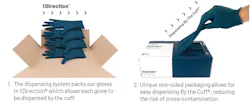
Their Compac™ nitrile glove system further reflects this approach through compact packaging intended to improve operatory organization while supporting cleaner dispensing practices. While glove packaging alone cannot replace established infection-control protocols, these innovations highlight how even small workflow adjustments may help reduce unnecessary touchpoints within the clinical setting.
Additional comparative research is still needed regarding contamination outcomes among various dispensing systems, but the discussion itself reinforces an important principle: infection prevention is influenced not only by clinician compliance but also by the design of the systems clinicians interact with every day.
In modern dentistry, seemingly minor details can carry broader implications for operatory asepsis. As practices continue refining protocols to create safer clinical environments, glove retrieval may deserve greater attention as part of a comprehensive infection-prevention strategy. Reducing unnecessary contact, evaluating workflow design, and incorporating cleaner retrieval methods may help strengthen existing protocols while supporting safer care for both clinicians and patients.
References
-
Kohn WG, Collins AS, Cleveland JL, et al. Guidelines for infection control in dental health-care settings—2003. MMWR Recomm Rep. 2003;52(RR-17):1-61.
-
Otter JA, Yezli S, French GL. The role of contaminated surfaces in the transmission of nosocomial pathogens. Infect Control Hosp Epidemiol. 2011;32(7):687-699.
-
Kampf G, Lemmen S. Disinfection of gloved hands for multiple activities with indicated glove use on the same patient. J Hosp Infect. 2017;97(1):3-10.
About the Author
 India Chance, BS, RDH, CDIPC
India Chance, BS, RDH, CDIPC
India Chance, BS, RDH, CDIPC, an acclaimed dental safety expert and founder of Learn2Prevent, excels as a registered dental hygienist and certified infection control educator. Recognized by the CDC, she champions global dental compliance and patient safety. Her leadership extends to roles with OSAP, Inside Dental Hygiene, and as a Maryland State Dental Board inspector. India's dedication was celebrated with the 2023 Emerging Infection Control Leader award in the US. Reach her at [email protected].