The view from the dental chair: Why learning to look outside the mouth matters
Key Highlights
- Dental hygienists can spot more than oral disease: Routine head and neck exams may reveal suspicious skin changes that patients often miss, supporting earlier medical evaluation.
- Know the high-risk areas: The ears, hairline, temporal region, and lower lip are common sites for sun-related skin changes and deserve careful observation.
- Observation, referral, and prevention matter: Recognizing abnormal findings, making timely referrals, and educating patients about sun protection and self-exams enhance comprehensive patient care.

Every day, dental hygienists spend about 60 minutes observing the head and neck area using direct illumination and magnification. We are already experts at examining the oral cavity, assessing the lips, evaluating lymph nodes, and documenting clinical findings. Still, some of the most important observations that we can make may occur outside the mouth. During a routine dental hygiene visit, we are in a privileged position that allows us to notice changes in the surrounding head and neck structures, sometimes areas that patients are not able to see for themselves (and may have never crossed their minds to check before), or that are surprisingly difficult for patients to monitor themselves.1
When we take the time to examine the head and neck area, we become thorough clinicians who can identify potential issues that might otherwise go unnoticed, providing our patients with a more comprehensive level of care. Whether it’s a subtle change in the skin, an unusual swelling, or something else entirely, our trained eyes can help identify potential problems early on and ensure that our patients receive the care they need.2
For us, the goal shouldn’t be to diagnose something outside our scope of practice, but to focus on our observational skills and to have the confidence to make an appropriate referral when needed. Because visibility does not equal observation, and sometimes what is visible can still be overlooked.
Looking outside the mouth without leaving our scope
The boundaries of dentistry have always been defined by the lips. That’s where we have concentrated all our efforts. However, as dental care evolves, so must our understanding of our professional boundaries. We must learn to look beyond the mouth, not because we wish to expand our scope of practice, but because we desire to use the perspective and knowledge we already have.
Our critical thinking skills do not lie in identifying the histopathologic name of a skin lesion or a suspicious pigmentation. Our value must rest in our own ability to detect discrepancies. We are already trained to understand health, symmetry, and balance. Therefore, we are uniquely equipped to recognize when the tissue says “I don’t belong here” or something that doesn’t look quite normal.
The areas the patient may never see
We need to ask ourselves how comfortable we feel discussing skin cancer awareness with our patients. If we wish to have a meaningful conversation, we need to understand that some areas on the head and neck are just more difficult for patients to see, monitor, or evaluate. We already spend much of the appointment looking at these regions from a unique perspective, and by understanding which sites are commonly overlooked, we can become more intentional observers.3
The superior helix of the ear
This blind spot is considered the area of the head that receives the most cumulative sun exposure. Changes in symmetry, irregular borders, changes in color, or lesions that appear different from the surrounding skin deserve our attention.
Behind the ear
Because the skin behind the ears is usually covered by hair, most patients rarely examine it and may be unaware of lesions simply because they never see them. Nonetheless, during dental hygiene appointments, this area becomes visible, allowing us to reveal findings that otherwise could go unnoticed.
The temporal region and hairline
This area represents the transition zone where the skin and hair intersect. Changes in this region often develop gradually, and patients may not notice them until a more severe alteration occurs. For clinicians who see patients repeatedly over many years, recognizing change may be easier than recognizing disease.
The lower lip: Where dentistry and dermatology meet
Out of all the sun-exposed structures visible during a dental appointment, the lower lip is the most clinically relevant. We examine it every day. Yet, how much do we know about the effect of chronic UV damage on the vermilion border?
Actinic cheilitis is precisely at the intersection where dermatology and dentistry meet. Dental hygienists may be among the first ones to notice early changes and encourage patients to seek appropriate evaluation, but this comes with a risk—the risk of familiarity.4,5
When we see the same structure over and over again, subtle changes, such as signs of persistent dryness, scaling, loss of vermilion border definition, and areas that do not heal, may be attributed in the beginning to weather, aging, or even dehydration. Yet these findings represent changes that require further assessment. Our job is to ask a few additional questions, document what we see, and encourage further evaluation when appropriate.6,7
At the end of the day, these locations share a common characteristic: they are easy for us to see and extremely easy for patients to overlook. Learning to look at these areas with intention is not about expanding our scope of practice but making good use of the perspective we already have.
Not all skin cancers behave the same way
When discussing skin cancer, we often talk about it as if it were a single disease. It is not. In reality, the different types of skin cancer we might encounter during a head and neck examination will look very different from one another.
Basal cell carcinoma, squamous cell carcinoma, and melanoma each have distinct clinical behaviors (ranging from aggressiveness to anatomical predilection). By understanding those differences, we can become better observers.
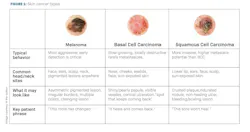
Basal cell carcinoma (BCC): The one that rarely metastasizes but rarely goes away
BCC is the most common skin cancer. It often appears on highly exposed areas of the face, particularly the nose and cheeks. The lesions may present as shiny papules with visible blood vessels or a central ulceration. Patients will describe them as an ulcer or a spot that “keeps coming back.” While it rarely metastasizes, it can become locally destructive if left untreated.8
Squamous cell carcinoma (SCC): The one we cannot afford to ignore
SCC behaves differently. It has a greater risk of metastasis and invasion and is associated with cumulative UV damage. The lesions may present as a persistent crusted lesion, an indurated plaque, or a nonhealing ulcer. For dental hygienists, the lower lip deserves particular attention.
Melanoma: The one everyone fears
Melanoma is often the skin cancer that receives the greatest attention, mostly because of its aggressive behavior and delayed diagnosis. In the head and neck area, melanomas tend to occur on the face, the back of the neck, the ears, and the scalp.8
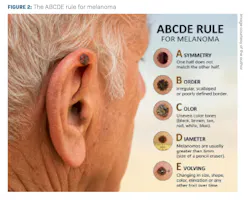
Melanoma is frequently evaluated using the ABCDE criteria:
- A: Asymmetry
- B: Borders
- C: Color
- D: Diameter
- E: Evolution
The ABCDE rule is a valuable screening tool for melanomas only and was never intended to identify other forms of skin cancer, because neither SCC nor BCC follows the ABCDE pattern. Hence, the most important lesson is that skin cancers will never announce themselves in the same way. Still, they all share a common denominator: they will always have inconsistent healing.
Prevention is also part of the conversation
Every dental appointment creates an opportunity to reinforce simple habits that may reduce the risk of skin cancer. We already know how to have conversations about oral cancer awareness and nutrition, but how about we start to see sun protection through the same lens?
For patients with significant sun exposure, discussing the importance of sunscreen, protective gear, and routine self-examination needs to be as relevant as discussing other preventive health measures. For example, many patients are unaware of the difference between lip-sun protection products and regular lip balm, or that artificial fragrances can increase the risk of perioral dermatitis compared to fragrance-free lip products.9
Equally important is teaching patients how to monitor themselves. A brief conversation during the appointment may be the first time a patient considers looking at these areas. By teaching them to self-examine their face, ears, lips, and scalp, we are promoting the type of awareness that extends beyond the dental chair.
Editor's note: This article appeared in the August/September 2026 print edition of RDH magazine. Dental hygienists in North America are eligible for a complimentary print subscription. Sign up here.
References
- Main B, Felstead A, Hughes C, Thomas S. A guide to skin cancer of the face for the dental team. Dent Update. 2014;41(2):111-118. doi:10.12968/denu.2014.41.2.111
- Kutcher MJ, Rubenstein D. Fifteen inches from cancer: early recognition of facial lesions by the dentist. Compend Contin Educ Dent. 2004;25(12):939-973.
- Roosta N, Wong MK, Woodley DT; Norris Comprehensive Cancer Center Melanoma Working Group. Utilizing hairdressers for early detection of head and neck melanoma: an untapped resource. J Am Acad Dermatol. 2012;66(4):687-688. doi:10.1016/j.jaad.2011.09.010
- Vasilovici A, Ungureanu L, Grigore L, Cojocaru E, Şenilă S. Actinic cheilitis – from risk factors to therapy. Front Med. 2022;9:805425. doi:10.3389/fmed.2022.805425
- Savage NW, McKay C, Faulkner C. Actinic cheilitis in dental practice. Aust Dent J. 2010;55(Suppl 1):78-84. doi:10.1111/j.1834-7819.2010.01202.x
- Lupu M, Caruntu A, Caruntu C, et al. Non-invasive imaging of actinic cheilitis and squamous cell carcinoma of the lip. Mol Clin Oncol. 2018;8(5):640-646. doi:10.3892/mco.2018.1599
- Milano AF. Lip cancer: 20-year comparative survival and mortality analysis by age, sex, race, stage, grade, cohort entry time-period and disease duration a systematic review of 19,213 cases for diagnosis years 1973-2014: (SEER*Stat 8.3.5). J Insur Med. 2023;49(4):1-12. doi:10.17849/insm-49-4-1-12.1
- Sibai L, Kudsi Z. Facial skin lesions dentists should know. Dent Update. 2015;42(6):520-524. doi:10.12968/denu.2015.42.6.520
- Buller DB, Andersen PA, Walkosz BJ, et al. Compliance with sunscreen advice in a survey of adults engaged in outdoor winter recreation at high-elevation ski areas. J Am Acad Dermatol. 2012;66(1):63-70. doi:10.1016/j.jaad.2010.11.044
About the Author
 Andreina Sucre, MSc, RDH
Andreina Sucre, MSc, RDH
Andreina Sucre, MSc, RDH, is an international dentist, oral pathology, and oral surgery specialist practicing dental hygiene in Miami, Florida. A passionate advocate for early pathological diagnosis, she empowers colleagues through lectures focused on oral pathologies. Andreina is the founder of The Patho RDH, a published author for RDH magazine, and a selected speaker at RDH Under One Roof 2026. Committed to community outreach, she educates non-native English-speaking children on oral health and actively volunteers in dental initiatives.