When the gloves come off: What natural disasters teach us about being health-care professionals
Key Highlights
- Clinical reasoning is a portable skill, enabling dental hygienists to assess, educate, and support patients even when technology and clinical infrastructure are unavailable.
- Disasters can have lasting oral health consequences, with stress, disrupted care, and limited access contributing to conditions such as xerostomia, bruxism, oral lesions, and untreated infections.
- Disaster preparedness extends beyond emergency response, highlighting the value of communication, clinical judgment, and interdisciplinary collaboration during long-term recovery.
There is a natural tendency to associate good clinical practice with the resources we have available in our operatory. Dentists and dental hygienists have been trained to work with proper lighting, digital radiographs, well-maintained instruments, reliable equipment, and carefully established protocols designed to protect both our patients and us.
Over time, these resources stop feeling like external tools and become an extension of ourselves. Without them, many of us would feel stripped of the tools that give us confidence.
But clinical reasoning does not begin with the perfect equipment. It begins the moment a clinician looks at a patient and recognizes that something isn't behaving as it should.
Before we name a disease, we try to understand what is happening.
Before we confirm a diagnosis, we become suspicious.
And no technology can fully replace the ability to observe with intention.
Ever since I moved to the United States and began my career as a dental hygienist, I have had the privilege of practicing in an environment where technology, standardized protocols, and interdisciplinary collaboration are the norm. Maybe that's why I had stopped asking myself one essential question: How much of my clinical training would remain if all of “this” disappeared tomorrow?
An earthquake rocked my world
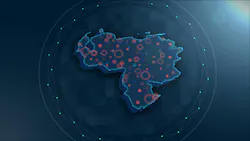
That question came back to me after the earthquake that hit Caracas this past June. My first reaction had nothing to do with dentistry; it was deeply human. I needed to know that my mom, my family, and the people I love were safe.
Only after that first wave of fear passed was I able to begin understanding the magnitude of what had happened.
In the days that followed, I spoke with colleagues who still practice dentistry in Venezuela. One friend could no longer work because the building where her practice was located had collapsed; for others, their dental offices had been declared unsafe to enter. And then there were the losses that no inventory could ever capture.
A dental assistant who had died.
A receptionist who would never return.
Entire dental teams grieving members who had suddenly become victims of the disaster themselves.
Soon afterward, social media began filling with images of dental students from universities across Venezuela volunteering wherever they were needed. I watched them care for patients outside hospitals, setting up makeshift dental clinics and examining people with nothing more than the light from a flashlight or a cell phone.
They had lost all the things we instinctively associate with providing excellent dental care. And yet they were still caring for people. That was not something to romanticize, because there is nothing admirable about losing infrastructure, equipment, or safe working conditions. But still, from afar, I admired their ability to continue thinking like clinicians after the entire environment that normally allows us to think clearly had disappeared.
Soon after the initial shock, two parts of me began to meet. My human side wanted to comfort, to help, to stand close to those who were suffering. And my clinical mind, the part of me trained to observe, analyze, and remain steady in uncertain situations, began asking: What skills made that response possible?
Portable clinical competencies
That was the moment I began thinking about what I now call “portable clinical competencies.” For me, this term describes the cognitive, interpersonal, and clinical abilities that remain available when the physical, technological, and structural resources we usually rely on become limited or disappear altogether.1,2
The concept asks a single question: What remains clinically available within a health-care professional when the usual supports of practice are no longer there?
For dental hygienists, those competencies are already a part of our everyday practice. We recognize changes that warrant follow-up and identify findings that require further evaluation. We educate, reassure, ask questions, document, refer, and work with uncertainty on a daily basis.
However, recognizing these competencies does not mean expanding our professional role. It is about how much of our education remains valuable when the context changes completely and the resources we normally depend on become limited.
The literature about disaster preparedness suggests that dentists and dental hygienists already have valuable skills that can be used alongside other health-care professionals and local authorities during emergencies. Our knowledge of anatomy, clinical assessment, radiology, infection control, communication, and teamwork represents an important resource when health-care systems are under pressure.3,4 But those skills do not automatically prepare us to respond to a disaster.
Disaster response requires specific training, organized systems, and an understanding of the chain of command.5,6 Portable clinical competencies are not meant to replace that preparation. Instead, they help explain why disaster preparedness should extend beyond the immediate emergency.
Disaster response is only a part of the story
What happens after the immediate emergency is over? What happens when the new challenge is caring for survivors after the clinical infrastructure itself has disappeared?
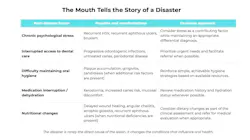
Although the available evidence is still limited, it points in the same direction. The disaster itself is rarely what affects oral health. But more often, it is everything that follows. Chronic stress, disrupted access to care, difficulty maintaining oral hygiene, interrupted medications, nutritional changes, and the emotional burden all become part of the patient’s clinical history (and story).7,8
In other words, the disaster itself is not what changes the oral cavity. It is everything that happens afterward. That is why oral health cannot be understood as separate from disaster recovery. It becomes part of it.9
This is where oral pathology enters the conversation
When we think about earthquakes, we usually picture fractures, traumatic injuries, facial wounds, or dental trauma. But once that first phase is over, another story begins, a quieter one that we don't always think about.
It is the moment when the body begins responding to everything it has experienced. Ongoing stress, lack of sleep, dehydration, interrupted medications, difficulty maintaining oral hygiene, and changes in immune function can all begin to show up inside the oral cavity.
We may start seeing recurrent herpes simplex infections, recurrent aphthous ulcers, oral candidiasis, xerostomia, bruxism, and odontogenic infections that continue progressing simply because treatment is no longer available.
The mouth tells the story of a disaster too
It’s not because every lesion can explain everything a patient has been through. And not because every clinical finding should automatically be linked to the traumatic event itself. Rather, oral tissues often reflect the cumulative effects of stress, disrupted routines, altered immune function, limited access to care, and the social consequences of living through a disaster.
A herpes outbreak, an aphthous ulcer, or signs of bruxism are more than possible diagnoses. Sometimes they are also part of the body's ongoing response to trauma. And this is where clinical judgment becomes important again.
- Recognizing the pattern
- Identifying contributing factors
- Providing relief whenever we can
- Educating
- Following up
- Knowing what we can manage
- Knowing when the patient needs immediate referral
Oral pathology does not begin with a diagnosis. It begins the moment a clinician recognizes that the oral mucosa is no longer behaving the way it should. That ability does not disappear because radiographs are unavailable, or because a biopsy cannot be performed right away, or because access to a specialist has been interrupted.
Despite the circumstances, clinical reasoning continues. Only the setting has changed.
The same patient who presents with recurrent aphthous ulcers, HSV reactivation, or signs of bruxism may also arrive exhausted, anxious, or struggling to tolerate touch and close proximity during an examination. In those moments, recognizing the lesion is only part of the clinical encounter, and helping the patient feel safe enough to let us examine it may be just as important.
Among these portable clinical competencies is the ability to reduce anxiety, slow a fear response, explain before touching, ask permission, recognize fear without minimizing it, and understand when a patient needs a moment before continuing. As dental hygienists, we may already be practicing many of these behaviors every day. Perhaps these actions have always been part of our clinical practice.10,11 They are part of our clinical reasoning.
Maybe that's why they are portable. They never belonged to the operatory in the first place. They have always belonged to the clinician, and they remain with us long after the gloves come off.
Editor’s note: This article first appeared in RDH eVillage newsletter, a publication of the Endeavor Business Media Dental Group. Read more articles and subscribe.
References
- Croskerry P. Adaptive expertise in medical decision making. Med Teach. 2018;40(8):803-808. doi:10.1080/0142159X.2018.1484898
- Mylopoulos M, Kulasegaram K, Woods NN. Developing the experts we need: fostering adaptive expertise through education. J Eval Clin Pract. 2018;24(3):674-677. doi:10.1111/jep.12905
- Khorram-Manesh A, Eskici GT, Gray L. Enhancing global disaster preparedness: a scoping review of the current integration of situational awareness and disaster mindset in healthcare education. AIMS Public Health. 2025;12(3):735-766. doi:10.3934/publichealth.2025038
- Newcomb TL, Bruhn AM, Giles B. Mass fatality incidents and the role of the dental hygienist: are we prepared? J Dent Hyg. 2015;89(3):143-151.
- Bradshaw BT, Bruhn AP, Newcomb TL, Giles BD, Simms K. Disaster preparedness and response: a survey of U.S. dental hygienists. J Dent Hyg. 2016;90(5):313-322.
- Janssen JA, Lampiris LN. Disaster response in Illinois: the role for dentists and dental hygienists. Dent Clin North Am. 2007;51(4):779-784. doi:10.1016/j.cden.2007.06.009
- Suzuki-Barrera K, Teramoto A, Sáez-Chandía J, Nakakuki K, Bracchiglione J. Oral health interventions in natural disasters: a scoping review. Disaster Med Public Health Prep. 2023;17:e388. doi:10.1017/dmp.2023.62
- Matsuda S, Yoshimura H, Kawachi I. Impact of natural disaster on oral health: a scoping review. Medicine (Baltimore). 2023;102(8):e33076. doi:10.1097/MD.0000000000033076
- Glotzer DL, Rekow ED, More FG, Godder B, Psoter W. All hazards training: incorporating a catastrophe preparedness mindset into the dental school curriculum and professional practice. Dent Clin North Am. 2007;51(4):805-818. doi:10.1016/j.cden.2007.06.003
- Simone CB, Smallidge DL, Libby L, Vineyard J. Experiences, knowledge and perceptions of dental hygienists, in the treatment of patients with post-traumatic stress disorder. J Dent Hyg. 2022;96(2):35-42.
- Drown DA, Giblin-Scanlon LJ, Vineyard J, Smallidge D, Dominick C. Dental hygienists' knowledge, attitudes and practice for patients with dental anxiety. J Dent Hyg. 2018;92(4):35-42.
About the Author
 Andreina Sucre, MSc, RDH
Andreina Sucre, MSc, RDH
Andreina Sucre, MSc, RDH, is an international dentist, oral pathology, and oral surgery specialist practicing dental hygiene in Miami, Florida. A passionate advocate for early pathological diagnosis, she empowers colleagues through lectures focused on oral pathologies. Andreina is the founder of The Patho RDH, a published author for RDH magazine, and a selected speaker at RDH Under One Roof 2026. Committed to community outreach, she educates non-native English-speaking children on oral health and actively volunteers in dental initiatives.