Tooth tales from the crypt
Key Highlights
- A medieval woman’s tooth containing lapis lazuli particles revealed that women likely played a larger role in manuscript illustration more than 900 years ago.
- Historical and forensic cases—from the radium-painted watch dial workers to modern investigations—show how teeth can uncover clues about health, occupation, and cause of death.
- Because enamel is the most durable substance in the human body, teeth can preserve evidence for thousands of years, helping scientists study diet, environment, migration, and identity long after death.
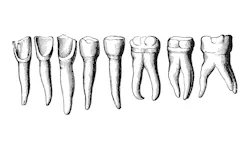
The other day, as I was mindlessly scrolling through Facebook, a photo of teeth popped up and caught my attention. The link was to a BBC news article titled, “Blue tooth reveals unknown female artist from medieval times.”1
Intrigued, I read the article. The teeth, complete with medieval calculus, were from the corpse of a woman, probably a nun, in a monastery in Dalheim, Germany, who lived more than 900 years ago. The “blue tooth” was actually hundreds of tiny particles of lapis lazuli embedded in the calculus on her tooth. It is thought that these particles got stuck in her plaque when licking the tip of a paintbrush dipped in a pigment made from lapis lazuli and ultramarine.
According to the article, “The discovery indicates that women were playing a far more significant role in the writing and illustration of manuscripts at this time than has previously been recognized. While there were women’s monasteries in this period, it had been believed that less than 1% of books could be attributed to them before the 12th century. Often women didn’t sign their names to books as a sign of humility, but the authors also believe there was a strong male bias at the time, and women were essentially rendered invisible. The authors say that their findings are helping to set the record straight.”
Because of this unknown woman’s tooth, we learned something new about history and culture in the medieval ages.
The Radium Girls
This article reminded me of a book I read a while ago titled, The Radium Girls.2 In the early 1920s, several young women contracted radium poisoning through licking the tips of paintbrushes dipped in radium, which was used to paint the dials of watches. They were repeatedly assured that this was a safe practice. When the young women realized that their clothes glowed in the dark, they began painting their nails, faces, and teeth with radium for fun.
Many of these young women lost their teeth and jaws through necrosis, before dying horrible deaths. One woman’s body was exhumed five years after her death and her bones, and presumably any teeth she still had, still glowed.2
Forensic dentistry
Forensic dentistry examines dental evidence in criminal cases. Forensic dentists may also assist in identification of human remains.
One of the weirdest experiences from my 48-year career as a dental hygienist occurred in 1978, my first year of practice. I was working for a GP, and an oral surgeon worked in the suite next door. One day some official-looking men arrived at our office with a box that was meant for the oral surgeon. He was not in that day, so the men left the box with my dentist to give to the oral surgeon when he came in the next day.
The box was left in our lab, and I picked it up to move it out of the way. It was then that I was told that the box I held in my hands contained a human skull of a murder victim, and that the oral surgeon, who was also a forensic dentist, would hopefully be able to identify the victim through dental records.
It is hard for me now to believe that evidence was handled so nonchalantly in those days, but, hey, it was the ’70s. I never found out the outcome of that case, but it piqued my interest in forensic dentistry.
Years later, I took a course in forensic dentistry, thinking maybe I could be the one to identify murder victims. I learned instead that much of forensic dentistry focused on analyzing bite marks, frequently on children. As the mother of young children at the time, I didn’t think I could handle that emotionally, so I abandoned the idea of working in forensic dentistry.
Dead teeth tell tales
While hygienists are more concerned with the teeth of the living, there is much to be learned from the teeth of the dead. In addition to identification of unknown bodies, the teeth of the dead can be examined to discover types of food people ate, health conditions, age of the deceased, cultural practices, geographical origins, and lifestyle indicators.3
As hygienists, we know that enamel is the hardest substance in the human body and can outlast skin, hair, nails, and bone. It is this resilience of enamel that makes teeth the most durable source of information of the dead.
One study of 30 teeth from 10 individuals who lived in Italy more than 2,500 years ago found that “microscopic patterns locked inside dental enamel and plaque reveal when children faced physiological stress, how diets shifted as they grew, and which foods adults regularly ate—including fermented staples that still define Mediterranean cuisine today.”4
Archaeologists near the city of Bordeaux in southwestern France excavated a site that was used as a burial mound beginning about 5,600 years ago and ending about 3,200 years ago. Scientists measured carbon, nitrogen, oxygen, and strontium isotopes from 25 teeth.5 Since tooth enamel retains a permanent isotopic signature, it reflects the environment and diet.
Using carbon and nitrogen isotope ratios, scientists concluded that the people in the French burial ground ate mostly terrestrial foods despite being near the ocean and a large river. Using oxygen and strontium isotopes, they concluded that most of the bodies were from the immediate area except for two who had spent their lives in different parts of France.5
Think of the thousands of teeth our hands have so skillfully touched over the years. Hundreds or thousands of years from now, when we are long gone, many of those teeth we touched will still be around, telling future scientists more tales from the crypt.
References
- McGrath M. Blue tooth reveals unknown female artist from medieval times. BBC. January 9, 2019. https://www.bbc.com/news/science-environment-46783610
- Moore K. The Radium Girls. Sourcebooks; 2018.
- What can the teeth tell you about the deceased? Biology Insights. August 18, 2025. https://biologyinsights.com/what-can-the-teeth-tell-you-about-the-deceased-2/
- Scott A. 2,500-year-old Iron Age teeth reveal how ancient childhoods and diets unfolded. Discover. January 14, 2026. https://www.discovermagazine.com/2-500-year-old-iron-age-teeth-reveal-how-ancient-childhoods-and-diets-unfolded-48539
- James HF, Griffith JI, Long K, Cheung C, Willmes M. The secrets in our teeth. Frontiers for Young Minds. March 22, 2022. https://kids.frontiersin.org/articles/10.3389/frym.2022.749555
About the Author

Kirsten Brancheau, BA, RDH
Kirsten Brancheau, BA, RDH, practiced clinical dental hygiene from 1978 until her retirement in 2025. She continues to work occasionally as a temp. Kirsten earned an associate’s degree in applied science in dental hygiene from Union County College and a bachelor of arts degree in English literature from Montclair State University. She is a member of the American Dental Hygienists’ Association. Kirsten is also a freelance proofreader, editor, and writer. She can be reached at [email protected].