Beyond the oral cavity: A hygienist’s early detection of thyroid cancer
Key Highlights
- A routine postpartum neck exam uncovered early thyroid cancer in a dental hygienist—reinforcing the life-saving value of thorough extraoral evaluations.
- Thyroid dysfunction is strongly linked to periodontal inflammation, reduced salivary flow, and increased caries risk, underscoring the need for dental teams to stay alert to systemic changes.
- Consistent, careful thyroid screening—palpation, symmetry assessment, and observation during swallowing—empowers oral health professionals to detect abnormalities patients may not notice.
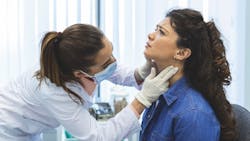
After her third pregnancy, dental hygienist Angeli Walton visited her OB-GYN for the standard six-week postpartum check. As he performed a neck lymph node and thyroid palpation, he noticed something “off.” He urged her to schedule a thyroid ultrasound, just to be safe.
Technique for thyroid evaluation
According to the Darby & Walsh Dental Hygiene: Theory and Practice textbook, the proper technique for thyroid evaluation is as follows: locate the thyroid cartilage and pass the fingers up and down the thyroid gland, examining for abnormal masses and assessing overall size. Then, place one hand on each side of the trachea and gently displace the thyroid gland tissue to the contralateral side of the neck while the other hand manually palpates the displaced tissue. Compare the two thyroid lobes for size and texture, using observation and bimanual palpation. Ask the patient to swallow, possibly with water, to check for gland mobility by observing its superior and inferior movement. Finally, bidigitally palpate both the hyoid bone and larynx, deliberately and gently moving each one.¹
Signs of thyroid cancer
Angeli herself didn’t feel any difference in her thyroid during self-palpation or have any noticeable signs or symptoms. However, once she delivered and could finally lie flat to sleep again, she began to notice dyspnea. “It just felt strange to breathe while on my back,” she recalled. “I’d turn on my side, and it would be fine—but lying on my back felt uncomfortable.”
Other general signs of thyroid cancer can include hoarseness or voice changes (due to involvement of the recurrent laryngeal nerve), difficulty swallowing (dysphagia), and a persistent cough not related to illness.
Initially frustrated by the extra appointments and the logistics of caring for three young children, Angeli’s intuition told her not to dismiss it. Although all her thyroid bloodwork returned normal, the ultrasound revealed two nodules. A biopsy followed—seven fine-needle samples were taken to test the tissue. The radiologist was very optimistic, but the results came back inconclusive.
Thyroid cancer: The statistics
According to the American Cancer Society’s 2025 report,2 approximately 44,020 new cases of thyroid cancer will be diagnosed in the US this year (12,670 in men and 31,350 in women), and about 2,290 deaths are expected (1,090 in men and 1,200 in women).
Thyroid cancer is typically diagnosed at a younger age than most other adult cancers, with the average age at diagnosis being 51. It is almost three times more common in women than in men and is about 40%–50% less common in Black individuals compared to other racial or ethnic groups.
Until recently, thyroid cancer rates were rising faster than any other cancer in the US, but with stricter diagnostic criteria, incidence rates have declined by about 2% overall per year since 2014.²
Diagnosis and recovery
Still uneasy with the inconclusive biopsy, Angeli sought out a top ENT who specialized in thyroid conditions. This led to a clear diagnosis: thyroid cancer. Surgical removal of the thyroid, along with lymph node sampling, confirmed the cancer was confined to the gland and caught early. Fortunately, there was no metastasis, and she avoided further treatment beyond surgery.
Recovery, however, proved challenging. Before her hormone replacement dose was properly balanced, Angeli experienced fatigue, insomnia, anxiety, dizziness, weight swings, and brain fog. “It was like my body didn’t know what it wanted to do,” she said. “Once the medication stabilized, I finally started to feel like myself again.”
Her endocrinologist now monitors her thyroid levels closely, with follow-ups every six months. During a later fourth pregnancy, frequent dose adjustments underscored just how carefully thyroid regulation must be managed.
Oral health implications
As a dental hygienist, Angeli’s experience reshaped her professional outlook. She realized that thyroid dysfunction has significant oral health implications, often overlooked in dental settings.
A 2025 systematic review and meta-analysis found that thyroid dysfunction is associated with increased periodontal disease indices, highlighting the need for further research into the mechanisms linking thyroid hormones and periodontal inflammation.3
In addition, patients with thyroid dysfunction, particularly those with autoimmune thyroid disease, demonstrate reduced unstimulated and stimulated salivary flow, lower saliva buffering capacity, and higher rates of dental caries compared to healthy controls.4 These findings suggest that oral health professionals must remain alert to subtle systemic changes that may influence their patients’ oral conditions.
“We are often the only health-care professionals some people see regularly,” Angeli reflected. “A thorough head and neck exam, including the thyroid, can save lives.”
She now understands, on a deeply personal level, the importance of taking time for comprehensive extraoral evaluations during every dental hygiene appointment.
Signs to watch for during a screening
- Palpable solitary or multiple nodules
- Fixed, hard masses (nonmobile with swallowing)
- Cervical lymphadenopathy (especially lateral nodes)
- Tracheal deviation or compression
- Absence of tenderness over nodules (in contrast to thyroiditis)
In a normal examination, the thyroid gland is not enlarged, tender, or abnormally firm, and it moves during swallowing. The larynx should also be nontender and freely movable when deliberately palpated.¹
The need for vigilance
Angeli’s story reminds us that sometimes the smallest moments of vigilance can lead to life-saving discoveries. What began as a routine postpartum checkup became a turning point in her life.
“I will always be grateful to that doctor who took the extra moment to check my neck, and to the path that followed, even though it was anything but easy,” she said.
Her journey underscores a profound truth for dental professionals: every routine exam holds the potential to reveal something extraordinary. Our responsibility extends far beyond the oral cavity; our hands and eyes may be the first to notice what patients themselves cannot feel.
Editor's note: This article appeared in the January/February 2026 print edition of RDH magazine. Dental hygienists in North America are eligible for a complimentary print subscription. Sign up here.
References
- Pieren JA, Amyot CC, eds. Darby & Walsh Dental Hygiene: Theory and Practice. 6th ed. Elsevier; 2024.
- Key statistics for thyroid cancer. American Cancer Society. Updated January 16, 2025. https://www.cancer.org/cancer/types/thyroid-cancer/about/key-statistics.html
- Ni J, Dan B, Lei F. The effects of thyroid function on periodontal status: a systematic review and meta-analysis. BMC Oral Health. 2025;25(1):289. doi:10.1186/s12903-024-05331-1
- Aparna KS, Manjunath PP, Uma SR. Association between dental caries experience and salivary profile among autoimmune thyroid disease subjects – a cross-sectional comparative study. F1000Res. 2023;12:833. doi:10.12688/f1000research.135684.1
About the Author
 Angeli Walton, BSDH, RDH
Angeli Walton, BSDH, RDH
Angeli Walton, BSDH, RDH, a Utah native raised in Holladay, is a dedicated dental hygienist and mother of four living in Lindon, Utah. After attending Brigham Young University and BYU–Hawaii, she graduated with honors from the Utah College of Dental Hygiene in 2009. Over the course of 16 years, she built a strong career working in private dental practices across the state. While she now limits her work to occasional temp jobs, Angeli remains passionate about health and wellness.
 Shelley Brown, MEd, BSDH, RDH
Shelley Brown, MEd, BSDH, RDH
Shelley is a dental educator, speaker, content creator, and mobile clinician dedicated to advancing accessible and innovative dentistry. As co-owner of HYGIENE edgeUCATORS, she empowers dental educators through professional development. Since 2009, she has taught at the Utah College of Dental Hygiene and founded Homebound Smiles, a mobile dental practice serving underserved patients. She received the 2026 Sunstar World Dental Hygienist award for her work in public health. You can find her on social media as Shelley_The_Hygienist and at www.shelley.dental.