Sharpness and wear rate of periodontal curettes
Key Highlights
- Standardized testing measured initial sharpness and wear rate of eleven scaler sets from seven manufacturers using CATRA's REDS platform.
- Lower cutting force values indicated sharper blades; dull blades were assigned the maximum force of 17.0N during testing.
- EverEdge 2.0 scalers showed the best initial sharpness and the slowest wear rate, suggesting longer-lasting performance.
- Edge wear was simulated over 500 cycles, providing insights into the durability of different scaler brands during repeated use.
- Findings support the importance of high-quality instruments for effective calculus removal, reduced clinician fatigue, and improved periodontal outcomes.
Abstract
Effective periodontal debridement remains fundamental to the management of periodontal disease. Successful non-surgical periodontal therapy relies upon efficient removal of biofilm and calculus, which depends in part on the sharpness and edge longevity of periodontal instruments.
The purpose of this study was to evaluate several scaler brands on initial sharpness and edge retention characteristics. The study used standardized mechanical testing to evaluate multiple samples of various scaler brands for initial (out-of-box) sharpness and rate of wear (over 500 cycles). As part of this evaluation, a test protocol was developed by CATRA (Cutlery Allied Trades Research Association). Equivalent tests were performed on instruments from each manufacturer and data was compiled so that direct comparisons could be made. Results indicated significant measurable differences in cutting edge performance across instrument brands and types.
EverEdge 2.0 scalers continue to exhibit an intrinsic resistance to edge wear and thus expected to last significantly longer than alternative brands. Also, HuFriedyGroup EverEdge 2.0 exhibited superior initial sharpness compared to alternative brands. These scalers provided the most consistent out-of-box sharpness across each tested sample set.
Clinical problem
Mechanical debridement to remove etiological and contributing factors, such as biofilm and calculus, remains the cornerstone of stabilizing the infection.1 The effectiveness of calculus removal is directly influenced by the blade sharpness.2 Variability in instrument quality can create challenges for clinicians during clinical use.
This paper presents standardized mechanical findings comparing the out-of-the-box initial sharpness and edge longevity of cutting edges among various periodontal instrument brands and types.
Evidence review
Treatment planning guidelines emphasize the importance of mechanical instrumentation or the effective treatment of periodontal disease.1 Results from a systematic review and meta-analysis showed that effective hand instrumentation led to superior outcomes in pockets ≥ 6mm.3 Instrument sharpness plays a key role in achieving better results during scaling, including greater accuracy, reduced clinician fatigue, reduced risk of tissue trauma, and a lower risk of burnishing calculus.4
Methodology
Laboratory testing was conducted by CATRA (Cutlery Allied Trades Research Association), a Sheffield, England laboratory founded in 1952 that specializes in independent evaluation of blade materials and cutting-edge performance. Eleven sets of instruments (all H6/7 sickle scalers), from seven different manufacturers were submitted to CATRA for testing. All eleven sets were brand new, unopened scaler packages.
Instrument sharpness and wear rate were evaluated using CATRA REDS (Razor Edge Durability and Sharpness) testing platform under standardized laboratory conditions. Initial sharpness was determined by measuring the cutting force required for each blade to penetrate the controlled test media. For each instrument, all four blade edges were tested. Cutting forces were accurately measured in Newtons (N) with lower force values indicating a sharper edge and higher force values indicating a duller edge. The maximum measurable force was 17.0N. If a blade was dull and unable to cut the test media, a value of 17.0N was assigned and noted. Cutting edge wear rate was assessed over 500 wear cycles to simulate repeated calculus removal strokes, with wear defined as an increase in cutting force from baseline under identical testing conditions across all instruments.
Statistical analysis was performed for each brand and type. The average initial sharpness, variation of out-of-box sharpness, and average wear rate were determined for each instrument group.
CATRA results
1. Initial (out-of-box) Sharpness
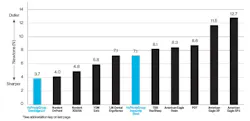
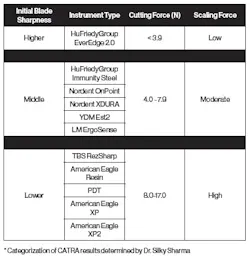
HuFriedyGroup EverEdge 2.0 exhibited the best out-of-box sharpness of all brands. HuFriedyGroup Immunity Steel, a mid-tier option, exhibited equal or better sharpness compared to 3 other brands.