Prognosis for teeth is a belief, not a prediction
Key Highlights
- Periodontal prognosis is less predictable than many clinicians assume, with research showing questionable and even hopeless teeth may survive far longer than expected.
- Treatment response—not the initial prognosis—should guide clinical decisions, making reevaluation and ongoing monitoring essential before considering extraction.
- Biofilm activity, risk factors, and patient response matter as much as radiographic findings, reinforcing the value of conservative periodontal therapy before replacing teeth with implants.
Prognosis for the teeth we worry about is no better than a coin flip. That is the key takeaway from the Prognosis Versus Actual Outcome series by McGuire and Nunn, a periodontist and a biostatistician. They followed periodontal patients and found that while we can predict outcomes for teeth with a good prognosis, we cannot reliably predict the fate of questionable or even hopeless teeth.1,2
In other words, gut feelings about tooth survival are not reliable. Even teeth with profound attachment loss can survive far longer than we tend to assume. Prognosis doesn’t fall in a linear fashion with bone loss. Furthermore, the survival of hopeless teeth can’t really be measured objectively, because they are usually extracted on the strength of the very factors that label them hopeless. This removes them from consideration before they ever get the chance to prove the label wrong.
Periodontal findings largely capture the long-delayed response to factors such as biofilm. Probing depth, radiographic bone loss, mobility, furcation involvement, and crown-to-root ratio are each significantly associated with tooth loss, yet taken together they make a surprisingly poor model of it.2 Stacking them mistakes redundancy for confidence. Models are rarely improved by adding more highly correlated inputs.
Periodontal charting doesn’t measure the disease itself, only the damage it leaves behind. Biofilms are expansive and chaotic, and we’re trying to predict their trajectory from what is largely a radiographic snapshot. At any given moment, sites are improving and worsening within the same mouth. Disease burden follows a heavy right-tailed distribution, with a few patients carrying most of the destruction. Systems like this don’t follow a normal distribution, behave linearly, or reduce to the kind of symbolic shuffling the 2017 classification attempts.3 Additional tools such as salivary testing, genetic risk markers, and smoking history sharpen the picture without ever completing it.4 Every new layer updates our belief about the patient; none of them delivers certainty.
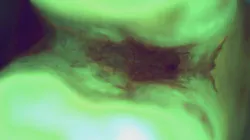
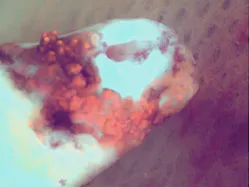
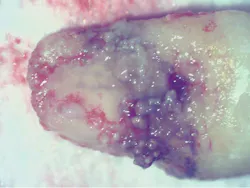
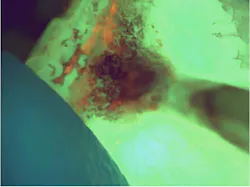
It is worth looking at the thing itself. Under violet light near 405 nm, sound tooth structure fluoresces green while the porphyrin-producing biofilm that drives this breakdown glows red-orange. This is brightest where the biofilm is oldest and most established.5-7 None of it appears on a chart, yet its activity is supposed to be captured probing depths and other measures.
We don’t know in advance how a patient will respond to treatment, which is exactly why we have to monitor closely. Treatment and the response to it are the real measures. We tend to be overly afraid of negative outcomes. I often hear dental professionals say a tooth is somehow “held in by calculus,” and worry that it will go mobile after scaling and root planing. But the only way to know is to treat the patient and watch what happens next.
This is the calculus we are discussing: a deposit dense with porphyrin-producing biofilm, reaching deep into the furcation where no instrument reliably follows.8
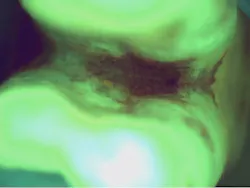
Treat the probing depths, bone levels, and mobility grades as a prior, not a verdict. They set your starting belief; then you intervene, control the risk factors you can, and monitor for stability or even improvement. The treatment is itself a test, and the response matters more than any periodontal snapshot.
In the age of implants, periodontally involved dentitions are frequently written off as hopeless without any attempt at periodontal therapy. The implant is no refuge from the biofilm, but only a fresh surface for it to colonize.
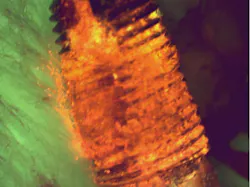
In reality, we should hold tooth prognosis loosely, commit to follow-up, and let the patient’s response be the thing we trust. And for most cases, nonresponse to periodontal therapy at the reevaluation is a key determinant of whether to refer for specialist care.9
Editor’s note: This article first appeared in RDH eVillage newsletter, a publication of the Endeavor Business Media Dental Group. Read more articles and subscribe.
References
- McGuire MK, Nunn ME. Prognosis versus actual outcome. II. The effectiveness of clinical parameters in developing an accurate prognosis. J Periodontol. 1996;67(7):658-665. doi:10.1902/jop.1996.67.7.658
- McGuire MK, Nunn ME. Prognosis versus actual outcome. III. The effectiveness of clinical parameters in accurately predicting tooth survival. J Periodontol. 1996;67(7):666-674. doi:10.1902/jop.1996.67.7.666
- Tonetti MS, Greenwell H, Kornman KS. Staging and grading of periodontitis: framework and proposal of a new classification and case definition. J Periodontol. 2018;89(Suppl 1):S159-S172. doi:10.1002/JPER.18-0006
- McGuire MK, Nunn ME. Prognosis versus actual outcome. IV. The effectiveness of clinical parameters and IL-1 genotype in accurately predicting prognoses and tooth survival. J Periodontol. 1999;70(1):49-56. doi:10.1902/jop.1999.70.1.49
- Van der Veen MH, Thomas RZ, Huysmans MC, de Soet JJ. Red autofluorescence of dental plaque bacteria. Caries Res. 2006;40(6):542-545. doi:10.1159/000095655
- Lennon AM, Buchalla W, Brune L, Zimmermann O, Gross U, Attin T. The ability of selected oral microorganisms to emit red fluorescence. Caries Res. 2006;40(1):2-5. doi:10.1159/000088898
- Coulthwaite L, Pretty IA, Smith PW, Higham SM, Verran J. The microbiological origin of fluorescence observed in plaque on dentures during QLF analysis. Caries Res. 2006;40(2):112-116. doi:10.1159/000091056
- Buchalla W, Lennon AM, Attin T. Fluorescence spectroscopy of dental calculus. J Periodontal Res. 2004;39(5):327-332. doi:10.1111/j.1600-0765.2004.00747.x
- Smiley CJ, Tracy SL, Abt E, et al. Evidence-based clinical practice guideline on the nonsurgical treatment of chronic periodontitis by means of scaling and root planing with or without adjuncts. J Am Dent Assoc. 2015;146(7):525-535. doi:10.1016/j.adaj.2015.01.026
About the Author
Joshua Grenier, DMD, MS
Joshua Grenier, DMD, MS, is a dentist in Coventry, Rhode Island, where he focuses on implants, IV sedation, and comprehensive dentistry. A Boston University graduate, US Air Force veteran, and owner of the digital dental laboratory Precision Removable, he holds a master’s in oral biology and maintains an active research interest in oral biofilm ecology, fluorescence microscopy, and dental disease. He writes at drjoshuagrenier.com.