The end-tuft brush: An underrated adjunct tool in dental hygiene
Key Highlights
- The end-tuft brush is an undertaught but highly effective adjunct for precision plaque control in complex, hard-to-reach oral areas.
- Its targeted design benefits patients with implants, orthodontic appliances, recession, furcations, crowding, or limited dexterity where standard tools fall short.
- Incorporating an end-tuft brush can improve plaque scores, gingival health, and patient compliance by increasing awareness and intention in daily oral hygiene.
Introduction
In dental hygiene school, we are educated on a plethora of oral hygiene tools to aid our patients in effective plaque control. A tool that is generally glossed over is the end-tuft brush. In my experience, I don’t recall a single quiz or board question about it, which made me think it was not important or outdated. When I began working in a periodontal practice, I was surprised to observe that the most suggested recommendation to patients from all three periodontists was utilizing an end-tuft brush. Hesitant at first to make the recommendation myself, it was the patients who opened my eyes to this tool. I saw the compliance, periodontally stable gums, and realized this tool has not been given the credit it deserves.
What is an end-tuft brush?
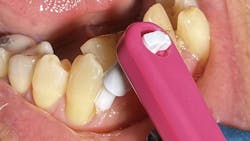
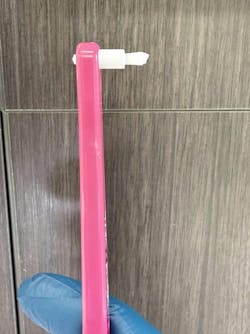
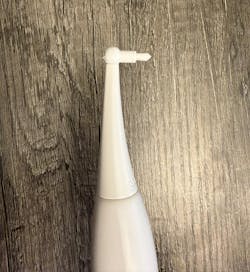
The end-tuft brush is a small, single-tufted, tapered brush designed to reach intricate surfaces of the teeth and gums that a standard toothbrush may not reach. Recommended as an adjunct tool to brushing and interdental cleaning, it is beneficial in areas where there is newly formed plaque. These areas include, but are not limited to, crowded spaces, direct distals and linguals of terminal molars, root surfaces, furcations, elongated gum lines, around orthodontic brackets, and implants.1
Who benefits most from its application?
As clinicians with years of hands-on practice, we often forget the layperson does not have nearly as much dexterity for fine motor skills as we do. This makes accuracy with oral hygiene practices unpredictable. An end-tuft brush is recommended for those who struggle with dexterity or hard-to-reach areas due to its targeted cleaning and precision plaque control. Being that the end-tuft is suspended on a sturdy, long handle allows for an extended reach when fitting fingers in the mouth for interdental cleaning is challenging. Additionally, a population of people this supplemental tool works well for are individuals with smaller mouths or those with limited opening. The end-tuft brush’s compact head allows for navigation in snug spaces with limited discomfort. Research by Lee et al. illustrates that plaque scores were drastically lower when participants in the study used an end-tuft brush combined with standard brushing rather than using a standard toothbrush alone.2
Where an end-tuft brush is best used
- Root exposure and furcations
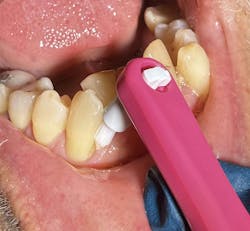
Because the root surfaces (dentin and cementum) are rougher and more permeable than enamel, there is a risk of increased bacterial adhesion to these surfaces. Root surfaces with anatomically complex curvatures such as furcations or elongated gingival margins add even more difficulty for plaque removal. Biofilm thrives around irregular gum margins where standard bristles are not properly adapted. This can lead to increased bleeding and bone loss.3 Adding a supplemental tool such as the end-tuft brush would allow for refining these complex areas with the increased cleaning time and the precision they need.
- Dental implants
The restorations that sit on dental implants often present with unique contours, crevices, and spaces that make thorough cleaning challenging. Fixed implant dentures and bridges hide food and debris, locator abutments have depressions on the top that collect food, and single implants have unique and often deeper pocketing in their natural state that make them more prone to gum disease. The tapered bristles of the end-tuft brush allow for reaching under the fixed bridges, scooping out debris sitting on top of locator abutments, and extending below the gumline of the implant for subgingival cleaning.
- Difficult-to-reach spaces
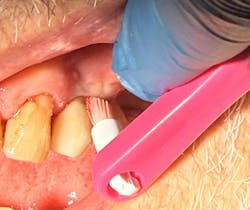
The brush’s single tuft can fit into nestled spaces where severe crowding, rotation, or overlap may not allow for a standard toothbrush to reach. Easier visibility of the tip of the tuft ensures accuracy when the operator is handling the tool, making cleaning the linguals and direct distals of molars easier. It also works exceptionally well around and under opercula, freeing these high-infection-risk areas of debris.
- Orthodontic appliances
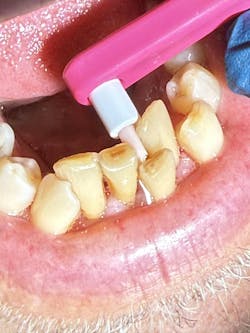
Good oral hygiene practice is already difficult for most without additional obstacles, so when the challenges of bands, brackets, and wires are added, it becomes even more tricky. The narrow design of the end-tuft brush allows for squeezing under wires, cleaning circumferentially around brackets, and between bands. Clinical studies have shown this results in a reduction in gingival inflammation and improved plaque control in patients with fixed orthodontic appliances.4
How to properly use an end-tuft brush
As a supplemental tool, it is recommended to use an end-tuft brush after toothbrushing and interdental cleaning for optimal plaque removal. Dip the end-tuft in mouth rinse or dentifrice, utilize the Bass technique by angling the brush 45° toward the gumline, and create sweeping motions that follow the curvatures of the tooth anatomy. For bridges and orthodontics, follow the same steps but also use the Charter’s technique by angling the brush toward the occlusal surfaces. With furcations, angle the brush into the root concavity and make small, circular motions.
Why recommend an end-tuft brush?
Although limited direct evidence exists, my clinical experience has witnessed that end-tuft brushes not only effectively remove biofilm, but they increase the operator’s overall awareness of complex areas, which in turn increases patient compliance. The core principles of the brush allow the patient to practice with intention and improve oral health via self-assessment.
In patients with complex areas, such as gum recession, implants, furcation involvement, or malocclusion, a standard electric toothbrush and floss regimen may not be enough. Increased complexity of the patient's mouth should prompt recommendations for additional oral hygiene practices beyond the standard regimen, such as increased cleaning time and supplemental tools like the end-tuft brush.
Conclusion
The goal of this article is to motivate clinicians to be open-minded to the recommendation of utilizing unconventional tools like the end-tuft brush for patients with complex oral characteristics. With complexity comes the need for additional time and tools to achieve overall healthy gums and teeth. The compact and tapered design on a long handle allows for accuracy and intention while being manageable for those with dexterity problems. Recommendation of the supplemental end-tuft brush may lead to decreased plaque levels, healthier appearance of gums, and patient compliance. This tool allows patients to take an active role in their oral health and wellness routine.
References
- Hasegawa I, Verissimo C,Montalli VA, Sperandio M, Peruzzo DC. Effectiveness of a single-tuft toothbrush for control of newly formed dental biofilm. Braz J Oral Sci. 2017;15(2):113.
- Lee DW, Moon IS. The plaque-removing efficacy of a single-tufted brush on the lingual and buccal surfaces of the molars. J Periodontal Implant Sci. 2011;41(3):131-134. doi:10.5051/jpis.2011.41.3.131
- Rajasekaran JJ, Krishnamurthy HK, Bosco J, et al. Oral microbiome: a review of its impact on oral and systemic health. Microorganisms. 2024;12(9):1797. doi:10.3390/microorganisms12091797
- Aykol-Sahin G, Ay-Kocabas B, Mert B, Usta H. Effectiveness of different types of toothbrushes on periodontal health in orthodontic patients with gingivitis: a randomized controlled study. BMC Oral Health. 2024;24(1):1289. doi:10.1186/s12903-024-05084-x
About the Author
 Shelby Wagenman, RDH
Shelby Wagenman, RDH
Shelby Wagenman, RDH, is a registered dental hygienist with three years of experience in periodontics. Prior to becoming a dental hygienist, she worked as a registered dental assistant in oral surgery. Her mission is to educate people via inspiring providers through her social media where she shares useful information pertaining to the dental hygiene field.