Brushing Beyond Plaque: Daily Oral Care as Functional Support for Kids
Key Highlights
- Open-mouth posture and mouth breathing in children shape facial growth and oral muscle function.
- Twice-daily brushing adds up to over 700 minutes yearly, repetition that builds lasting patterns.
- U-shaped brushes like Willo make brushing a built-in practice for lip closure and nasal breathing.
- Habit stacking lets parents reinforce functional cues during brushing without adding time or steps.
- Hygienists can coach families with simple cues connecting oral hygiene to healthy mouth function.
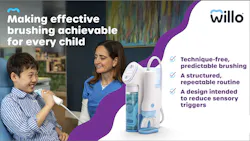

Most of us think of toothbrushing as a simple hygiene routine. Two minutes, twice a day, focused on keeping teeth clean and preventing disease. But what if those same two minutes could serve another purpose? What if brushing could also support how a child’s mouth functions; how they breathe, how their lips rest, and how their muscles work, without adding anything new to a family’s routine?
Why This Matters More Than We Think
As hygienists, we tend to catch these patterns early, simply from the time we spend with our patients and the close view we have. Open mouth posture. Low tongue position. Kids who can’t keep their lips together and are mouth breathers. These aren’t just “phases.” They are patterns that are being practiced every single day. Research has shown that mouth breathing in children is linked to changes in facial growth and oral muscle function over time.1 We also know that mouth breathing will affect oral health with clinical signs of bleeding gums or an increase in cavities. However, when we look at prevention through a functional lens, it’s not just about plaque and cavities. It’s about what the mouth is learning to do all day long. What happens every day in the mouth can shape how the face and jaws grow over time.
Where Brushing and Function Meet
At first, brushing and myofunctional therapy feel like two totally different worlds. But when you step back, they overlap more than we realize. Both involve what the lips are doing, how the child is breathing, how the jaw is moving and how the mouth responds to input.
Myofunctional therapy has been shown to help improve oral habits like mouth breathing, jaw posture, and lip function in children. The part that’s easy to miss is that kids are already doing a version of this work every time they brush when using a U-shaped brush like Willo.
If a child brushes twice a day for two minutes, that adds up to over 700 minutes a year. That is a lot of repetition and repetition is how patterns stick. Right now, most of that time is just focused on getting teeth clean. It can also become a time where we gently guide better patterns without adding anything new to the routine. When we look at brushing through a functional lens, it becomes a simple way to reinforce:
Lip Closure: Keeping the lips gently sealed around the Willo brush encourages activation of the muscles around the mouth. For kids who struggle with open mouth posture, this is built-in practice.
Nasal Breathing: If the lips are closed and the brush is in, the child must breathe through their nose. That’s a powerful cue without needing extra tools or exercises.
Jaw Stability: Instead of chasing the brush or chewing on it, kids can learn to stay still and steady. By gently biting down on the Willo brush, this helps to build awareness and control.
Oral Tolerance: For kids with a strong gag reflex or sensory sensitivity, brushing can slowly help them build tolerance over time. Having options with the Willo brush with timing and brush strength also gives kids autonomy.
That’s not a separate therapy session. That’s just brushing, done with a little more intention. We know parents are not looking for more to do. They are already stretched and busy. Instead of starting with a long list of exercises, we can give them something that fits into what they already do every day.
This is where the idea of habit stacking comes in, from the book Atomic Habits. It’s the idea that new habits stick better when they are paired with something that already happens consistently.2 Hopefully, brushing is one of the most consistent routines a child has. We don’t need to make it complicated. We can coach parents to guide their child during brushing with a few simple cues: keep lips closed gently around the brush, breathe through the nose, don’t chew the brush and choose what modes are desired for the brushing cycle.
No extra time. No extra steps. Just a small shift in awareness with pairing brushing with functional activities.
Where Tools Like Willo Fit In
Some kids struggle with brushing not because they don’t want to do it, but because it’s hard. It takes coordination and focus. This is where tools like Willo can help to support the process. Willo uses an automated brushing approach designed to clean all tooth surfaces at once, which can take some of the technique and guesswork out of brushing.
From a functional standpoint, that consistency can create an opportunity. With the Willo brush in place doing the work, children can focus on keeping their lips closed, breathing through their nose, and staying relaxed. That can mean less stress for the child, less frustration for the parents and overall, more consistency. And consistency is where change actually happens.
What This Means for Us as Hygienists
We are often the first to notice these patterns. The good news is that we do not need to overhaul routines to make an impact. Sometimes it’s as simple as saying: “While they’re brushing, have them keep their lips closed and breathe through their nose.” When we connect oral hygiene with how the mouth functions, we give families a new way to look at something they are already doing every day.
Pediatric oral health is not just about keeping teeth clean. It’s about how the mouth develops, rests, and functions over time. The small things kids repeat every day shape those outcomes. Brushing is one of the few routines that happen consistently, twice a day, in almost every home. When we start to see it differently, we can use it differently. Not as another task. But as an opportunity.
References
- Zhao, Z., Zheng, L., Huang, X., Li, C., Liu, J., & Hu, Y. (2021). Effects of mouth breathing on facial skeletal development in children: a systematic review and meta analysis. BMC oral health, 21(1), 108.
- Clear, J. (2018). Atomic habits: An easy & proven way to build good habits & break bad ones. Avery.

Joy Lantz, RDH, PHDH, COM, IBCLCis a dental educator, consultant, and clinician dedicated to advancing integrative, prevention-focused care. She earned certification in orofacial myology through the International Association of OrofacialMyology (IAOM) in 2017 and currently serves as IAOM President. In 2022, she became an International Board-Certified Lactation Consultant (IBCLC), further deepening her whole-body approach to oral health. Joy is the founder ofJoy Lantz:Transforming Oral Health, where she educates patients, parents,and professionals while consulting with dental practices seeking to thoughtfully integrate airway-centered care. Her passion lies in empowering dental and medical teams to collaborate in early screening for oral myofunctional and airway disorders to support lifelong health.