5 tips all new grads need for creating a resume
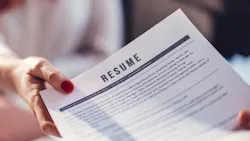
Those hiring spend an average of six to eight seconds on an initial resume scan to decide if they’d like to bring you to the next step of interviewing.1 That’s why the resume is an important document—it needs to be clean, balanced, and easy to read to offer a good first impression of you. Here are five tips to help you stand out and draw employers in.
1. Keep it to one page
The National Association of Colleges and Employers (NACE) states that a one-page resume is preferred for early-career applicants. If it turns into two pages, it becomes harder to scan and often feels too wordy.2 Employers are busy, and if they cannot quickly find what they are looking for, they may move on.
Think of your resume as a highlight reel, not your entire story. You want just enough information to spark interest and secure the interview. You can always provide a more detailed version later, such as a curriculum vitae, if needed. Short, clear, and intentional always wins.
2. Be strategic about personal information
You do not need to include your full physical address on your resume. While this used to be standard, it can sometimes introduce bias. An employer might make assumptions about your commute, your living situation, or your level of “stability” based on where you live. None of that reflects your work ethic or your reliability. You already proved your commitment by showing up to school every day, being on time, and completing a rigorous program. Instead, include your phone number, professional email, and your LinkedIn profile. That is more than enough for an employer to contact you.
3. Use your space wisely
Every inch of your resume matters. White space is important for readability, but large empty sections, especially in areas like the bottom corner, are missed opportunities. That space could be used to highlight a skill, an accomplishment, or an experience. Conversely, do not cram information on the page just to fill space. Balance is key; you want your resume to feel full but not overwhelming.
It’s also important to remember your previous work experience matters, even if it is not in dentistry. If you worked in food service, retail, or any customer-facing role, you gained valuable skills. You developed communication, multitasking, time management, and customer service, all of which are essential in dental hygiene. For example, creating a great experience for a patient is not that different from creating a great experience for a customer. Those skills translate, so make sure you connect the dots for the employer.
4. Highlight your clinical skills and tools
As a new grad, your clinical experience is your biggest asset. Do not assume something is “too basic” to include. If you learned it, it counts. Think about:
-
Software systems you used in clinic
-
Any additional screenings, such as airway assessments or myofunctional therapy screenings, caries and periodontal risk assessments etc.
-
Equipment you trained on, like lasers, air polishers, or digital imaging or scanning systems
Not all dental hygiene programs are the same, and not all students graduate with the same experiences. Listing these skills shows what you bring to the table right away. This is also where you can stand out.
5. Skip the objective and consider a photo carefully
Objectives are outdated on resumes. They take up space without adding much value. If you want to share your goals or your “why,” save that for your cover letter and use your resume to highlight your skills, education, and accomplishments.
Adding a photo is a personal choice. Many dental offices prefer them, as it helps employers connect a face to the name. If you choose to include one, make sure it is professional. Think clean, polished, and appropriate, for example, a photo of you in scrubs with your loupes. Avoid casual photos or personal images like wedding pictures. That said, it is completely okay to leave a photo off your resume. There is always a possibility of bias, and you get to decide what feels right for you. A great middle ground is to include a professional photo on your LinkedIn profile and add your LinkedIn link, or even a QR code, to your resume. This gives employers the option to learn more about you without taking up space on the page.
Final thoughts
Your resume needs to be clear, intentional, and reflective of who you are as a new professional. You have already done the hard work. You showed up, you learned, you practiced, and you built real skills. Now your job is to present that in a way that is easy to read, easy to understand, and hard to ignore. Keep it simple, keep it focused, and most importantly, make it work for you.
References:
-
Your resume gets 6 seconds. Here's what recruiters actually see. Leon Staff. May 24, 2026. https://leonstaff.com/blogs/recruiter-resume-6-second-scan/
- When to use two pages or more. Purdue University. https://owl.purdue.edu/owl/job_search_writing/resumes_and_vitas/using_two_pages_or_more.html
About the Author
 Shelley Brown, MEd, BSDH, RDH, FADHA
Shelley Brown, MEd, BSDH, RDH, FADHA
Shelley is a dental educator, speaker, content creator, and mobile clinician dedicated to advancing accessible and innovative dentistry. As co-owner of HYGIENE edgeUCATORS, she empowers dental educators through professional development. Since 2009, she has taught at the Utah College of Dental Hygiene and founded Homebound Smiles, a mobile dental practice serving underserved patients. She received the 2026 Sunstar World Dental Hygienist award for her work in public health. You can find her on social media as Shelley_The_Hygienist and at www.shelley.dental.