How clean are your instruments? Manual vs. automated cleaners
Key Highlights
- Proper cleaning is essential before disinfection or sterilization and must remove all organic and inorganic debris.
- Automated cleaning is preferred when instruments are compatible, reducing injury risk and improving removal from hard-to-reach areas.
- Follow manufacturer instructions, use appropriate PPE, and inspect instruments after cleaning to ensure effective reprocessing.
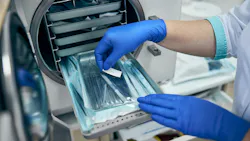
Cleaning dental instruments and devices is the first critical step of disinfection and sterilization. Cleaning is the removal of foreign material from instruments and items used in any health-care facility. Meticulous cleaning is required before high-level disinfection and sterilization can occur. Materials, either inorganic or organic, that are left on instruments impede the effectiveness of these processes.1-4
In addition, if materials become dried on the items, the removal process becomes more difficult. This in turn will make the sterilization/disinfection processes ineffective.1,2,4
Best practices for cleaning instruments
Cleaning devices and instruments can be done either manually or automatically. It should be done as soon as possible after the items have been used to prevent drying of materials on the devices.
When cleaning is not done immediately, a holding solution may be used to keep debris moist to facilitate cleaning later. A holding solution is not needed when instruments are cleaned soon after use and after being transported to the reprocessing area. If a holding solution is utilized, remember to use an enzymatic detergent or solution deemed a holding solution. Never use a high-level disinfectant for a holding solution.2
Manufacturers’ instructions for use must be followed when utilizing cleaning agents to ensure compatibility with the instruments and effective cleaning. An important factor to consider when cleaning instruments is the nature of the object. When hinges, crevices, lumens, or complex moving parts are present, these require special attention to cleaning. Disassembling and opening the hinges may be necessary to properly clean the device.3,5,6
Manual cleaning
Manual cleaning is used when automated cleaners aren’t available, or when the items are fragile or difficult to clean. When performing manual or utilizing automated cleaning, it is imperative that the appropriate personal protective equipment (PPE) be worn. Cleaning of instruments requires the use of detergents and water. Never use a high-level disinfectant for cleaning.1,2,7
There are two components of manual cleaning: friction and fluidics. Friction is accomplished by rubbing/scrubbing the soiled instruments with a long-handled brush. Fluidics means fluids under pressure, and it is used to remove debris from the internal aspects of a device after cleaning. This occurs when a brush cannot pass through the internal components of a device.2,4
When manual cleaning is performed:2,7
- Use work practice controls to reduce the chance of sharps injuries.
- Clean only two or three instruments at a time.
- Never reach into trays or containers holding sharp instruments that cannot be seen.
- Scrub instruments low in the sink under running water, and use a long-handled brush to keep the scrubbing hand away from sharp instruments.
- Wear appropriate PPE, including puncture-resistant, heavy-duty gloves.
- Inspect all instruments for any remaining debris.
- Dry instruments by allowing them to air-dry or by carefully patting (not rubbing) with several thicknesses of towels.
After cleaning, instruments should be rinsed with water to remove detergent residue, taking care to minimize splashing. Clean instruments are not sterile; clean simply means all debris has been removed. Sterilization or high-level disinfection must occur after cleaning.1-3,7
Automated cleaning
Automated or mechanical cleaning is the preferred method for processing when the items are compatible. Automated cleaners offer several advantages: they improve the removal of blood, bioburden, and debris from difficult-to-reach areas; reduce the risk of injury during handling; and help save time in the reprocessing area.1,2,7
The most common types of mechanical cleaning are ultrasonics and washer-decontaminators/disinfectors. All equipment used for cleaning must be FDA-approved. Household dishwashers are not FDA-approved to clean medical/dental instruments.4-6
Ultrasonic cleaners
Ultrasonic cleaners use cavitation to remove debris from the instruments.
These things are important to consider when using an ultrasonic cleaner:2,5-7
- Always follow the manufacturers’ instructions for use (IFU) on solutions used, test recommendations, and maintenance needed. The amount of solution and cycle times for loose instruments versus cassettes is found in these instructions.
- Test cleaning solution for effectiveness by using the aluminum foil test or commercially available test vials. The foil test is the most common method. This is done by immersing a strip of foil at least 2” wide and 3” long in the cleaner for 20 seconds. When you remove the foil, if evenly distributed dents are present, the cleaner is working. If they are not present, the cleaner needs to be serviced. Testing must be done at least monthly or more often following IFU.
- Don’t overload the tank! The instruments should be placed loosely in the basket, submerged completely in the solution. The lid of the ultrasonic must be in place while running to reduce aerosols.
- Use the appropriate solution for the ultrasonic. Never use disinfectants—these may create the potential for hazardous fumes being released. Follow IFU for solution types for the cleaner.
- Rinse instruments after the cycle. If the instruments were in a holding solution prior to the ultrasonic, rinse the instruments prior to placing them in the ultrasonic cleaner.
- Inspect instruments to ensure debris has been removed.
- Once the cycle and rinsing are complete, allow the instruments to dry. Dried instruments will reduce rusting or wicking when packaged.
- The best practice is to empty the ultrasonic daily or when IFU states a frequency.
Washer-decontaminators/disinfectors
A washer-disinfector/washer-decontaminator is another automated device used in health-care settings to clean, decontaminate, and disinfect heat-resistant and heat-sensitive items. These are FDA-regulated devices and work like a household dishwasher. They use a combination of water temperature, detergent, and spray technology to remove bioburden, ensuring instruments are safe for handling and sterilization. They are commonly used for rigid endoscopes, utensils, basins, and anesthesia equipment. Maintenance of the device is done by checking, cleaning, and ensuring proper function for optimal disinfection.4-6
Once this critical step of cleaning to remove all debris from instruments and devices used in dental health-care settings is complete, the instruments will be ready for packaging and sterilization. Remember, cleaning is critical and the first step toward optimum sterilization!
Additional reading:
- Keeping your instruments' cutting edges: When, why, and how to sharpen
- Raising the standard: A hygienist's journey with dental instrument cassettes
Editor's note: This article appeared in the October 2026 print edition of RDH magazine. Dental hygienists in North America are eligible for a complimentary print subscription. Sign up here.
References
- Sterilization and disinfection. Centers for Disease Control and Prevention. Updated May 15, 2024. https://www.cdc.gov/dental-infection-control/hcp/summary/sterilization-disinfection.html
- Kohn WG, Collins AS, Cleveland JL, Harte JA, Eklund KJ, Malvitz DM; Centers for Disease Control and Prevention (CDC). Guidelines for infection control in dental health-care settings--2003. MMWR Recomm Rep. 2003;52(RR-17):1-61.
- Infection control and sterilization. American Dental Association. https://www.ada.org/resources/ada-library/oral-health-topics/infection-control-and-sterilization
- Cleaning: guideline for disinfection and sterilization in healthcare facilities (2008). Centers for Disease Control and Prevention. Updated November 28, 2023. https://www.cdc.gov/infection-control/hcp/disinfection-sterilization/cleaning.html
- Reprocessing of reusable medical devices: information for manufacturers. US Food and Drug Administration. Updated September 27, 2018. https://www.fda.gov/medical-devices/device-advice-comprehensive-regulatory-assistance/reprocessing-reusable-medical-devices-information-manufacturers
- Reprocessing medical devices in health care settings: validation methods and labeling. Guidance for Industry and Food and Drug Administration staff. US Food and Drug Administration. Updated June 13, 2018. https://www.fda.gov/regulatory-information/search-fda-guidance-documents/reprocessing-medical-devices-
health-care-settings-validation-methods-and-labeling - Best practices for sterilization in dental settings. Centers for Disease Control and Prevention. Updated May 15, 2024. https://www.cdc.gov/dental-infection-control/hcp/dental-ipc-faqs/dental-sterilization.html
About the Author
Renee Russell, BHS, RDH, CDIPC
Renee has been a Total Medical Compliance consultant since 2016, specializing in OSHA, HIPAA, and infection control since 2008. With more than 30 years in dental care, she’s served as a dental assistant, RDH, and compliance officer. Renee earned her BHS from the Medical University of South Carolina and was named South Carolina's Dental Hygienist of the Year in 2010. She is CDIPC-certified, a speaker, and a Hu-Friedy key opinion leader.