Caring with clarity: Using KPIs as a tool to enhance patient care
Key Highlights
- Reframe dental hygiene KPIs as tools for improving patient care—not measures of personal worth.
- Track metrics such as treatment acceptance, recare rates, periodontal percentage, and fluoride acceptance to identify opportunities.
- Use KPI data to strengthen communication, coaching, accountability, and long-term patient outcomes.

Disclosure: If the term KPI (key performance indicator) is triggering, this article may not be for you. Its purpose is to help dental hygienists understand how KPIs can reflect the quality of care they provide to patients. They are not about pushing treatment; they are tools that can help demonstrate patient engagement, preventive care efforts, and positive health outcomes.
Many people are drawn to dental hygiene because it is grounded in patient care, prevention, and education. Dental hygienists help patients feel informed, comfortable, and confident while supporting both oral and overall health. Yet, once we enter clinical practice, the focus often shifts toward production. By staying connected to our dental hygiene roots while also examining the services patients accept, we can better understand how effectively we care for them.
Related reading: What we measure matters: Expanding the metrics of dental practice success
When KPIs entered the picture
Roughly 20 years ago, Machell found a dream opportunity, and within a month, nearly walked away from it. For the first time, the care being provided truly changed patients’ quality of life. Then came the request to begin tracking key performance indicators (KPIs). Instantly, the experience felt anxious, judged, and not good enough. The care once praised by doctors and the office manager suddenly felt reduced to numbers, like becoming a human spreadsheet.
But leaving was not an option. Machell was hooked on hearing patients say the care was changing their lives. The work connected sleep, airway, inflammation, and oral health in ways that reached far beyond what was taught in college. That experience created space to listen to the lead doctor, Dr. Baird, and consider a new perspective: what if KPIs were not there to judge, but to support growth? Yes, there was some eye-rolling at first too.
Seeing KPIs in a new light
Over time and with a change in your mindset, you will see KPIs differently. Instead of viewing them as a measure of our worth, you will see them as a tool to better understand patient care. KPIs can feel uncomfortable at first. However, when used with the right intention, they help identify where patients may need more support.
As preventive specialists and periodontal therapists, we play a key role in connecting oral health to overall health. KPIs can help reveal where patients may be losing confidence during the clinical explanation, the handoff, or scheduling. This clarity matters because feedback is most effective when it focuses on specific areas with meaningful opportunity for improvement.1
Dentistry has shown this as well. In a randomized trial of nearly 800 general dental practices, showing dentists their own prescribing data changed clinical behavior.2 Digital scans, disclosing solution, and KPIs all serve a similar purpose: they make the invisible visible. They do not replace compassionate care; they help strengthen it.
Numbers you should know
An important number to understand is your personal conversion rate. This is the percentage of patients who accept the treatment or care you have recommended. Reflecting on your conversion rate also opens an important conversation about how dental hygienists use their appointment time. RDHs often have the most uninterrupted time with patients in the practice, giving them significant influence in patient care. With that influence and time comes responsibility. While cost is often assumed to be the main reason patients decline treatment, many say no because they do not fully understand their condition, the risks of delaying care, or the value of the recommended treatment.
The recare book-back rate and frequency matter because it reflects continuity of care. The ADA suggests approximately 90% of recare patients should leave with their next visit reserved.3
Patients who stay consistent with periodontal maintenance lose significantly fewer teeth over time, with one meta-analysis showing a 44% lower risk of tooth loss compared to noncompliant patients.4
When patients miss recare appointments, their disease risk does not disappear. Tracking book-back rates and recare frequency helps us reconnect sooner and helps manage patients’ disease risk. Ensuring patients leave with their next visit reserved creates value, urgency, accountability, and clarity that will support improved long-term oral health.
Tracking periodontal percentages can feel uncomfortable because it may highlight cases where periodontal therapy is being delivered but not accurately billed or coded. The Centers for Disease Control and Prevention estimates that nearly 50% of adults over 30 have periodontitis, increasing to more than 70% by age 65.5 Yet many practices identify and treat periodontal disease far below that level. According to Dental Intelligence 2025 benchmarks, the average periodontal percentage is 16%, while a healthy practice range is often closer to 35%–60%, depending on practice demographics.6
Fluoride percentage is another important KPI to understand. Nearly 90% of adults ages 20 to 64 have experienced dental caries, and almost 50% of people in the US have used at least one prescription medication in the past 30 days, many of which can impact salivary flow and caries risks.7,8 This KPI is not simply about product acceptance; it is about reducing disease, supporting prevention, and helping patients understand the value of protecting their oral health.
KPIs you should be tracking
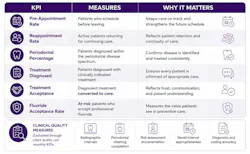
To help grow your practice and enhance patient care, here are a few the KPIs you should be tracking (figure 1):
- Preappointment rate
- Reappointment rate
- Periodontal percentage
- Treatment diagnosed
- Treatment acceptance/conversion rate
- Fluoride acceptance rate
Even with clear metrics, KPIs are not magic. Simply tracking numbers does not automatically improve treatment acceptance. What matters is how the data is used through meaningful feedback, coaching, and team alignment.1
Telling an RDH, “Your numbers are too low,” is not leadership.
Strong coaching asks better questions:
- What are we seeing?
- Where are patients becoming uncertain?
- What systems or communication can we improve?
The number should start the conversation, not replace it. When KPIs feel like a weapon, they create defensiveness and shame. When used well, they create clarity, accountability, collaboration, and growth. The goal is never to reduce a hygienist to a percentage. The goal is to use data to elevate patient care and help patients manage chronic inflammatory disease earlier, protect their health, and improve quality of life.
“Show me the numbers”
This brings us to the most important message of this article, one of the most powerful things a hygienist can say in a meeting with doctors, managers, or leaders is, “Show me the numbers”—not to defend ourselves, but to better understand where our patients need us most. The right KPIs help us turn that care into measurable action, better outcomes, and greater impact.
Let’s not be fearful of KPIs. When used with the right intention, they help us see where we can grow as professionals, strengthen our communication, and serve our patients with greater clarity and purpose. Caring for patients is the mission, and KPIs will help us be successful with the right intention.
Editor’s note: This article first appeared in RDH eVillage newsletter, a publication of the Endeavor Business Media Dental Group. Read more articles and subscribe.
References
- Ivers N, Jamtvedt G, Flottorp S, et al. Audit and feedback: effects on professional practice and healthcare outcomes. Cochrane Database Syst Rev. 2012;2012(6):CD000259. doi:10.1002/14651858.CD000259.pub3
- Elouafkaoui P, Young L, Newlands R, et al. An audit and feedback intervention for reducing antibiotic prescribing in general dental practice: the RAPiD Cluster Randomised Controlled Trial. PLoS Med. 2016;13(8):e1002115. doi:10.1371/journal.pmed.1002115
- Measuring success in dental practice. American Dental Association. https://www.ada.org/
- Lee CT, Huang HY, Sun TC, Karimbux N. Impact of patient compliance on tooth loss during supportive periodontal therapy: a systematic review and meta-analysis. J Dent Res. 2015;94(6):777-786. doi:10.1177/0022034515578910
- Periodontal disease in adults (age 30 or older). National Institute of Dental and Craniofacial Research. Reviewed August 2021. https://www.nidcr.nih.gov/research/data-statistics/periodontal-disease/adults
- State of Dentistry 2026 report. Dental Intelligence. https://www.dentalintel.com/ebooks/the-state-of-dentistry-2026
- Dental caries (tooth decay) in adults (ages 20 to 64 years). National Institute of Dental and Craniofacial Research. https://www.nidcr.nih.gov/research/data-statistics/dental-caries/adults
- Therapeutic drug use. Centers for Disease Control and Prevention. National Center for Health Statistics. Reviewed January 10, 2025. https://www.cdc.gov/nchs/fastats/drug-use-therapeutic.htm
About the Author
 Machell Hoover, RDH, CHC, FAAOSH
Machell Hoover, RDH, CHC, FAAOSH
Machell Hoover, RDH, CHC, is an integrative dental hygienist, speaker, and educator with over 20 years of clinical experience. As founder and CEO of Integrative Dental Coaching, she teaches dental teams a risk factor-based approach to care. Machell believes the dental hygiene profession plays a critical role in overall health and is passionate about elevating patient care. She serves as a subject matter expert at Spear Education, hygiene educator at 3D Dentists, and guest faculty with the American Academy of Dental Sleep Medicine. She also sits on the advisory boards of DentistryIQ and American Academy for Oral Systemic Health. Her mission is to give hygienists the clinical confidence and communication skills to practice at the top of their license and change the way patients experience care.
 Kerry Lepicek, RDH
Kerry Lepicek, RDH
Kerry Lepicek, RDH, is a registered dental hygienist with more than 20 years of clinical experience and currently serves as clinical specialist, dental hygiene and education at Clinical Research Dental. A published author and sought-after international speaker, Kerry is recognized for her expertise in oral biofilm management, teeth whitening, halitosis, the oral-systemic connection, and the dental hygiene process of care. She is a section editor for Women in Dentistry, a member of the Ontario Dental Hygienists’ Association Research Advisory Committee, and an advisory board member for RDH magazine. Kerry is also the recipient of the ODHA Distinguished Service Award, honoring her outstanding contributions and commitment to advancing the dental hygiene profession.