Worn out? Work smarter, not harder with your ultrasonics inserts/tips
Key Highlights
- Worn ultrasonic inserts reduce efficiency fast—as the tip wears, amplitude/sweep drops, making calculus harder to remove and scaling less effective.
- Overcompensating increases risk for both clinician and patient—pushing harder can contribute to musculoskeletal disorders, while worn tips can burnish calculus and deliver substandard care.
- Use manufacturer wear guides + an office SOP to stay ahead—measure tips routinely, follow each brand’s reorder/replace thresholds (often 1–2 mm, with some exceptions), and assign clear responsibility for monitoring and replacement.
Do you get a serotonin rush when your ultrasonics inserts/tips (UITs) blast the calculus off? But what happens when it seems like nothing is working? Consider if the UIT is worn past its effectiveness. Wear causes the amplitude or the sweep of the UIT to decrease.
Musculoskeletal disorder (MSD) prevalence
Our natural response is to grip more firmly and push harder when deposits are not coming off. The ideal force should be the same as a periodontal probe, about 20–25 grams.1 While common, excess force can contribute to MSDs, having significant impact on the provider’s hand health.2
Worn UITs can cause harm to patients and the practice
Worn UITs can also cause harm to patients and the practice. Patients aren’t receiving the care for which they or a third-party payor has paid. Worn UITs are merely polishing the rough edges of calculus, creating hard-to-remove burnished calculus. Workplace safety could generate issues for the practice because substandard UITs were provided by the employer. These scenarios are 100% preventable.
Manufacturers’ role
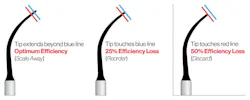
Cavitron first introduced wear guides in the mid-1980s. The standard has been 1 mm of wear, resulting in 25% decrease in scaling efficiency, and 2 mm wear to only 50% efficiency. Dentsply Sirona demonstrated their brand of worn inserts showing a 30% increase in scaling time and 40% more force when compared to their new inserts.3 HuFriedy magneto advocates to reorder when the tip touches the blue line.4
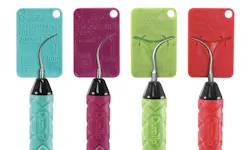
In 2023, Parkell introduced the new paradigm of a performance guide for DuraTip magneto included with every insert that is color-matched to the grip. Autoclavable, it can be placed in a sterilization bag or cassette, making it easy to locate for measurement. Unlike other guides, it shows only a 3 mm marking since DuraTip performs like new up to 3 mm of wear.5
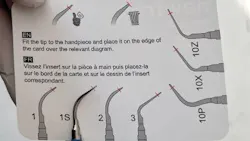
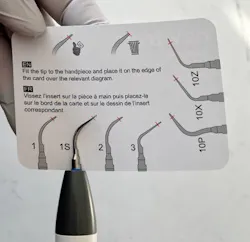
ACTEON piezo updated their wear guide in 2026 to a single card featuring their most popular tip styles of the over 80 tips they offer. EMS piezo Instrument Check Tool with one marking at 2 mm represents a 50% decrease in efficiency.6 Follow each manufacturer’s recommendations on how often to measure, when to reorder, and when to discard UITs.
Measuring checklist
Step 1: Create a page in your office standard operating procedure (SOP) manual.
- Who will measure
- How often
- Who the decision-maker is for replacement
- Who will place the order
Step 2: Acquire the appropriate guides from the manufacturer.
- Contact the manufacturer rep or customer service department to get the most updated guide—manufacturers update their guides periodically.
Step 3: Alignment is key.
- Magneto: Align the insert tip according to manufacturer’s recommendations. DuraTip has an indented channel to ensure proper alignment.
- Piezo: Screw the tip onto the handpiece. This will help ensure proper alignment against the piezo guide. EMS also has an indented channel to ensure proper alignment.
Step 4: Measuring. 1, 2, 3 mm wear
1 mm wear
- If your UIT wear guide has a 1 mm marking and the UIT measures with 1 mm loss, group them together.
o Place a dot of colored nail polish on the UIT for easy recognition
o Expect 25% less efficiency at 1 mm wear and the need to use sharp hand instruments to compensate for loss in cleaning efficiency from the worn UIT.
2 mm wear
- UITs worn 2 mm are 50% less efficient and should be removed from service and replaced.
3 mm wear
- Parkell DuraTip is the only insert that claims like-new performance up to 3 mm wear
Follow manufacturers’ instructions for use (IFU) regarding when to reorder and when to discard. Let the UITs do the work. Work smarter, not harder.
Financial Disclosure: Paschke Ultrasonix receives royalties for Parkell Dura-Tip; Ultrasonics Plus receives consulting fees from Parkell, ACTEON, and other corporate sponsors.
Editor's note: This article appeared in the March 2026 print edition of RDH magazine. Dental hygienists in North America are eligible for a complimentary print subscription. Sign up here.
References
- Al Shayeb KN, Turner W, Gillam DG. Accuracy and reproducibility of probe forces during simulated periodontal pocket depth measurements. Saudi Dent J. 2014;26(2):50-55. doi:10.1016/j.sdentj.2014.02.001
- Eddhaoui M, Syed MA. Prevalence of musculoskeletal disorders among dentists in primary healthcare settings in Qatar: a cross-sectional study. Cureus. 2025;17(7):e87257. doi:10.7759/cureus.87257
- The impacts of ultrasonic insert tip Dentsply Sirona. YouTube. Accessed December 8, 2025. https://www.youtube.com/watch?v=SRvJ4hCKEeI
- Biernat Insert wear guide: check the efficiency of your ultrasonic inserts! Friends of Hu-Friedy. https://www.friendsofhu-friedy.com/s/news/a2H36000001xsypEAA/insert-wear-guide-check-the-efficiency-of-your-ultrasonic-inserts
- DuraTip ultrasonic inserts by Parkell. YouTube. Accessed December 8, 2025. https://www.youtube.com/watch?v=GjQBC_b030c
- How to use the PIEZON check EMS. YouTube. Accessed December 8, 2025. https://www.youtube.com/watch?v=MvHjNjtIhSw
About the Author
 Noel Slotke Paschke, MS, BSDH, RDH
Noel Slotke Paschke, MS, BSDH, RDH
Noel is an award-winning former faculty at the University of Maryland Dental School and has led three international companies’ education departments, including Dentsply Cavitron, Philips Sonicare, and Acteon. She offers consulting and educational services through her company Ultrasonics Plus. Contact her at [email protected].
Richard Paschke, MS, BS
Richard is a dental ultrasonic engineer, mentored by one of the founding physicists-inventors at Cavitron. After a 30-year career at Cavitron and subsequently Dentsply, Richard started Paschke Ultrasonix, where he provides engineering services to many dental companies.
Together they are known as Mr. and Mrs. Ultrasonics.