Early Palatal Expansion: Better Bites, Better Breathing, Better Home Care
Key Highlights
- Early palatal expansion can widen the airway, correct crossbite, and reduce snoring in children.
- Snoring in children may signal airway restriction requiring an orthodontic evaluation.
- Orthodontic appliances create biofilm traps that raise the risk of white spot lesions.
- Full-mouth toothbrushes like Willo AutoFlo+ simplify thorough brushing around appliances.
- Interproximal care remains essential, since no toothbrush fully replaces flossing.

As a registered dental hygienist and a parent, I’ve seen firsthand how early orthodontic intervention can change the trajectory of a child’s oral and overall health. One of the most impactful experiences in my own home involved my son, who, at just 8 years old, presented with a narrow palate, posterior crossbite, and something many parents might overlook: chronic snoring.
Snoring in children is often dismissed as harmless, but it can be a sign of underlying airway restriction. In my son’s case, his orthodontic evaluation revealed that his maxilla was too narrow, limiting not only proper occlusion but also the space available for nasal airflow. The recommended treatment was rapid maxillary expansion (RME), commonly known as a palatal expander.
Palatal expansion is a well-established orthodontic procedure used to widen the upper jaw by gradually separating the midpalatal suture in 2-3 weeks. This is most effective in children, as the suture has not yet fused, allowing for skeletal changes rather than just dental movement.
Research supports both the structural and functional benefits of this treatment. A randomized clinical trial comparing different types of expanders (banded vs. bonded) found that both approaches successfully produced skeletal and dental expansion, although the way forces were distributed differed depending on the appliance design (Viarani et al., 2025). Additionally, systematic reviews have shown that RME can improve airway dimensions and support better breathing in pediatric patients, particularly those experiencing sleep-disordered breathing (Piełunowicz et al., 2025).
Our orthodontist recommended a traditional palatal expander, and I was given the responsibility of turning the key daily. The initial plan was three weeks of activation, but after reevaluation, we extended it another three weeks for optimal expansion.
What amazed me most was the biological process happening in real time. Each day, the appliance applied gentle pressure to gradually separate the palatal suture creating microscopic changes that allowed new bone to form and stabilize the expansion. This is a perfect example of how growth modification in children can be both powerful and efficient.
One of the most visible signs of success was the development of spacing between his anterior teeth, a completely expected and reassuring outcome. By the end of the six-month retention phase, the transformation was undeniable. His bite had improved significantly, his arch was wider, and importantly, his snoring had reduced.
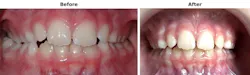
While the orthodontic results as you can see were exciting, they introduced a new challenge: maintaining effective oral hygiene. Any orthodontic appliance, whether it’s a palatal expander, braces, or other fixed devices, creates additional biofilm-retentive areas. These appliances make it significantly more difficult for children to properly clean around teeth, especially along the gingival margin and interproximal surfaces.
This is where many patients run into trouble. Without proper home care, the risk of demineralization, gingivitis, and even early periodontal issues increases. As dental professionals, we’ve all seen the unfortunate outcome of orthodontic treatment paired with poor hygiene: white spot lesions around brackets and compromised enamel. The goal is clear, we never want a child to complete orthodontic treatment with a healthier bite but damaged tooth structure.
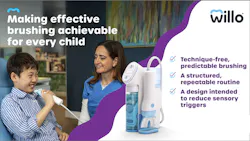
This is where tools like full mouth toothbrushes can make a meaningful difference. For children, especially those navigating orthodontic appliances, simplicity and consistency are everything. The Willo AutoFlo+ is designed as a full-mouth toothbrush that automates several key steps of oral hygiene. It delivers the appropriate amount of toothpaste, uses mechanical motion to clean all tooth surfaces, and suctions away excess fluid, creating a cleaner and more controlled brushing experience.
What makes this particularly valuable during orthodontic care is accessibility. Children often struggle with traditional brushing techniques, especially when brackets, wires, or expanders are involved. A device that can simultaneously reach multiple surfaces, maintain proper angulation, and reduce reliance on manual dexterity can significantly improve outcomes.
With proper training and supervision, children can learn how to correctly position a full-mouth toothbrush and incorporate it into their daily routine. For parents and caregivers, this can reduce the stress of ensuring thorough brushing while still supporting independence. However, it’s important to emphasize that no toothbrush can fully replace interproximal care. Flossing, water flossers, or interdental brushes, remain essential, especially when orthodontic appliances are present.
Early orthodontic intervention, like palatal expansion, has the potential to do far more than straighten teeth, it can improve airway health, support proper growth, and set the foundation for lifelong oral wellness. Treatment success doesn’t end with the appliance, it depends heavily on what happens at home every day.
As both a clinician and a parent, I’ve seen how critical it is to pair orthodontic care with effective, accessible hygiene strategies. Whether through traditional methods or innovative tools like the Willo AutoFlo+, (Check out the video HERE) the goal remains the same: protecting the health of the teeth and gums while supporting optimal development