Are your shoes hurting you?
Key Highlights
- Footwear can influence how forces travel through the kinetic chain, potentially affecting the knees, hips, back, and neck.
- Narrow toe boxes can restrict the big toe and interfere with natural foot mechanics, potentially contributing to strain higher up the body.
- A properly fitted, foot-shaped shoe—with a toe box that allows natural toe movement—can be a simple but meaningful addition to clinical ergonomics.
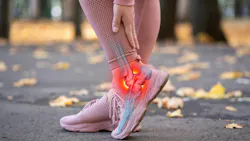
It’s the end of a long clinical day. The usual postwork pain sets in: sore feet, tired knees, stiff hips, and achy low back. We rightfully blame our posture, our schedule, or years spent practicing. While those factors certainly matter, there may be a contributor we don’t often think about: our shoes.
I’m not suggesting that you toss out every pair of shoes in your closet, that one specific shoe brand prevents all pain, or that there’s a universally “best” shoe for everyone. What research shows is that footwear can influence how forces travel through the body, potentially changing movement patterns.1
Everything is connected
Think of the body as one continuous kinetic chain where everything is connected (because it is). Every time the foot contacts the floor, ground forces travel upward through the ankle, knee, hip, pelvis, and spine. Small changes in foot mechanics influence the joints above them. For dental clinicians who spend hours on our feet, weight shifting, balancing, and maintaining static postures, those small changes are repeated hundreds, or thousands, of times throughout the workday.
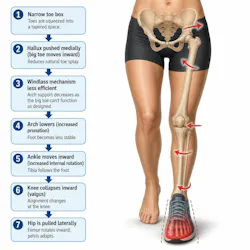
Modern footwear differs in many ways, including cushioning, heel-to-toe drop, stability, flexibility, arch support, and the shape of the toe box. While these characteristics may seem minor, each has the potential to influence how the lower extremity functions during standing and walking, which can move up the chain to the back, shoulders, or neck (figure 1).
The shape of the toe box
One feature that deserves particular attention is the shape of the toe box. Many modern shoes taper toward the front, squeezing the toes together for hours at a time. The big toe (hallux) plays a much larger role than simply helping you balance. During walking, it helps activate the Windlass mechanism, a natural system in which the plantar fascia tightens, helping stiffen the foot and support the arch during push-off.2
When the big toe is repeatedly pushed toward the smaller toes, this mechanism often becomes less efficient. The result can be altered foot mechanics, changes in arch behavior, increased tibial rotation, altered knee alignment, and increased hip strain during standing and walking.3,4
This doesn’t mean everyone needs minimalist footwear or even the widest shoe available. However, selecting a foot-shaped shoe with a toe box that allows your toes to rest in a more natural position helps preserve optimal foot mechanics throughout long clinical days. Research also suggests that footwear perceived as comfortable may encourage more natural movement patterns than shoes that feel restrictive or force the foot into an unnatural position.5
A foot scan
Here’s a solution for your next shoe purchase: a foot scan. Some athletic shoe stores, like Fleet Feet, can tell you everything you never knew about your forefoot width, heel width, arch health, and more with a simple 10-second scan of your feet. They take that information and give you recommendations on exactly which shoes should fit your feet the best to allow the most effective functioning. Don’t be surprised if the ones they recommend feel weird at first, as many of our feet haven’t had the opportunity to work properly in years. As a girl who always wore tight, narrow-toed Nikes, I was definitely surprised! It can take time to get used to having room in your shoes, but don’t worry, your feet will take up the space if you give them the chance. Mine did!
We invest in back-saving saddle stools, neck-saving loupes, and hand-saving instruments to reduce physical strain. Why not invest in knee- or hip-saving shoes? They deserve a place in the ergonomic conversation, because choosing footwear that supports natural foot mechanics may be one of the simplest ergonomic upgrades you make this year.
Editor's note: This article appeared in the October 2026 print edition of RDH magazine. Dental hygienists in North America are eligible for a complimentary print subscription. Sign up here.
References
- Chen SF, Wang Y, Peng Y, Zhang M. Effects of attrition shoes on kinematics and kinetics of lower limb joints during walking. Front Bioeng Biotechnol. 2022;10:824297. doi:10.3389/fbioe.2022.824297
- Hicks JH. The mechanics of the foot. II. The plantar aponeurosis and the arch. J Anat. 1954;88(1):25-30.
- Kelly LA, Cresswell AG, Racinais S, Whiteley R, Lichtwark G. Intrinsic foot muscles have the capacity to control deformation of the longitudinal arch. J R Soc Interface. 2014;11(93):20131188. doi:10.1098/rsif.2013.1188
- Rodrigues P, Chang R, TenBroek T, van Emmerik R, Hamill J. Evaluating the coupling between foot pronation and tibial internal rotation continuously using vector coding. J Appl Biomech. 2015;31(2):88-94. doi:10.1123/jab.2014-0067
- Branthwaite H, Chockalingam N, Greenhalgh A. The effect of shoe toe box shape and volume on forefoot interdigital and plantar pressures in healthy females. J Foot Ankle Res. 2013;6:28. doi:10.1186/1757-1146-6-2
About the Author
 Katrina Klein, RDH, CEAS, CPT
Katrina Klein, RDH, CEAS, CPT
Katrina is an 18-year registered dental hygienist, national speaker, author, competitive bodybuilder, certified personal trainer, certified ergonomic assessment specialist, and biomechanics nerd. She’s the founder of ErgoFitLife, where she teaches that ergonomics and fitness are a lifestyle to prevent, reduce, and even eliminate workplace pain. You can reach Katrina at [email protected].