Seeing is believing with ultrasonics and perioscopy
Key Highlights
- Periodontal endoscopy offers direct, high-magnification visualization of subgingival biofilm and calculus, improving precision in minimally invasive debridement and helping clinicians avoid both under- and overinstrumentation.
- Advanced ultrasonic and implant-safe tip systems, when paired with endoscopic guidance, allow more efficient removal of deposits around natural teeth and implants—often increasing treatment effectiveness within a single visit.
- Despite the upfront investment, clinicians report strong clinical and business value, with improved case acceptance, expanded services, and new practice models such as mobile hygiene and in-office specialty collaboration.
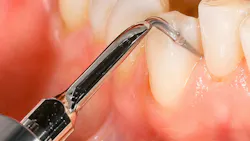
The use of periodontal endoscopes is not new to dental hygiene. Master clinicians, including Anna Pattison, Suzanne Newkirk, and others, have been using this technology for years. Recently, renewed interest has surfaced with improvements made to the technology.
Observing Kristen Ranaldo at Max Dental Group in Hicksville, New York, performing ultrasonics with endoscopic enhancement made my RDH heart sing. Kristen’s patients have the option to receive this advanced, minimally invasive therapy with the endoscope. They are informed there is an additional fee and that insurance providers will not provide benefits. The patients do not hesitate. It is all in how it is presented.
Additional reading:
- Inquiring minds want to know: Mr. and Mrs. Ultrasonics answer your questions
- Worn out? Work smarter, not harder with your ultrasonics inserts/tips
The endoscope and direct visualization
Armed with her periodontal endoscope, the stage is set. The DH care plan was four quads of nonsurgical therapy with local anesthesia including treatment of failing implant on no. 18. Direct visualization, working with the endoscope, significantly increases the amount of treatment that can be provided in a single appointment.
Jacques Cousteau’s underwater explorers would have been impressed at what we could see subgingivally with the endoscope. At 100x magnification, the implant came into view. Biofilm and calculus in between the threads could now be easily seen—no guessing. Seeing the calculus being blasted off subgingivally was exhilarating.
Not over- or underinstrumenting
Using an endoscope enables clinicians not to underinstrument, leaving calculus and perhaps as concerning, not overinstrumenting, causing root damage. Not too little and not too much; just right. It is a Goldilocks moment. Residual and burnished calculus can be seen with the endoscope.1-3
Kristen used piezo curved titanium implant-safe tips (figure 1) on low power on implant no. 18. The tip fit in between the threads where the calculus was located.
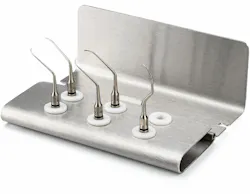
In contrast, conical shaped UITs are very challenging to gain access in between the threads that are subgingival, if at all. Kristen quickly removed soft and hard deposits using horizontal strokes only around the implant. In addition to the implant, Kristen provided thorough debridement on natural teeth using right and left curved tips as well as a tip with probe markings tip (figure 2).
Periodontal endoscopes are an investment
Clinicians can maximize services with this technology and often find the equipment can pay for itself in a few months. Some manufacturers include in-person clinical coaching, workflow maximization, business coaching, and scripting for case acceptance.
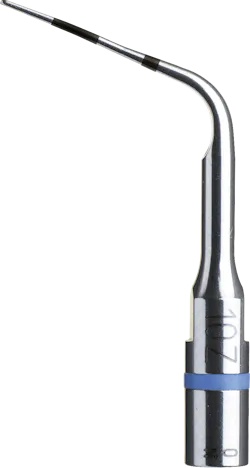
Marvelyn Navarro is the cofounder and co-owner of Perio Precise.4 As a mobile RDH, she takes her endoscope and instruments to various practices. Marvelyn uses magnetostrictive ultrasonics in her procedures (figure 3).
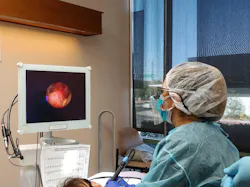
In addition to providing clinical care, other services offered through Perio Precise are presenting national continuing education courses in-person and virtually, and training and coaching, with an emphasis on clinical application. Marvelyn’s goal is to elevate care with vision, noting medical procedures would be considered substandard care if performed blindly.5
“It feels like serving”
Melanie Boyd, founder of New Wave Perio, utilizes her endoscope in various general practices that want to keep the patients in the practice. She says, “It doesn’t feel like selling; it feels like serving.”6 The guest hygienist model which brings the equipment is appealing to the general practices by keeping the initial prep in-house and positively impacting production. It also creates patients who, if needed, are ready to transition to the periodontist for more complex procedures. This forms a strong referral bond between the general dentist and periodontist.
Combining technologies you’ve mastered like ultrasonics with another high-level technology such as the periodontal endoscope is worth investigating. RDHs are health-care professionals, not technicians. We think. We evaluate. We learn and discern. Your patients and your practice will thank you.
More from the author: New insights on ultrasonics
References
- Pattison AM, Pattison GL. Periodontal instrumentation transformed. Dimensions of Dental Hygiene. July 14, 2004. Accessed March 30, 2026. https://dimensionsofdentalhygiene.com/article/periodontal-instrumentation-transformed/
- Wennstrom JL, Lindhe J, Nyman S. Residual calculus after debridement with or without adjunctive periodontal endoscopy: a clinical assessment. J Periodontol. 2014;85(9):1199-1206.
- Ramfjord SP, Hill RW. A comparison of residual subgingival calculus after scaling with a periodontal endoscope versus conventional scaling. J Periodontol. 2013;84(11):1605-1612.
- Treating patients with vision and precision. Perio Precise. https://periopreciserdh.com/
- Navarro M. Dental endoscopy: the most underutilized technology in modern dentistry. DentistryIQ. March 8, 2026. Accessed April 1, 2026. https://www.dentistryiq.com/dentistry/article/55362431/dental-endoscopy-the-most-underutilized-technology-in-modern-dentistry
- Boyd M. How this dental hygienist turned restriction into opportunity with mobile periodontal services. RDH. August 28, 2025. Accessed March 30, 2026. https://www.rdhmag.com/career-profession/alternative-practice/article/55312721/how-this-dental-hygienist-turned-restriction-into-opportunity-with-mobile-periodontal-services
About the Author
 Noel Slotke Paschke, MS, BSDH, RDH
Noel Slotke Paschke, MS, BSDH, RDH
Noel is an award-winning former faculty at the University of Maryland Dental School and has led three international companies’ education departments, including Dentsply Cavitron, Philips Sonicare, and Acteon. She offers consulting and educational services through her company Ultrasonics Plus. Contact her at [email protected].