Inquiring minds want to know: Mr. and Mrs. Ultrasonics answer your questions
Key Highlights
- Magnetostrictive (Cavitron) and piezo ultrasonics operate differently, including variations in tip motion, technique, and adaptation during scaling.
- Loud piezo scaling often signals improper technique, typically from rolling onto the back of the tip instead of using the lateral surfaces.
- Ultrasonic tip selection matters—power limits, design, and root anatomy all influence which inserts provide the safest and most effective instrumentation.

Monitoring social media and teaching magneto and piezo ultrasonics, we have collected many ultrasonic questions. These are a few questions inquiring minds would like to know more about. Note UIT refers to ultrasonic insert or tip.
I have never used piezo? How is it different from my Cavitron?
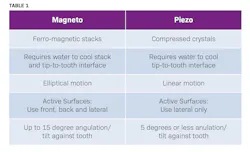
Magneto (Cavitron-type) and piezo are different in the following five ways (table 1):
I’m new to piezo. Why is my piezo scaling so loud?
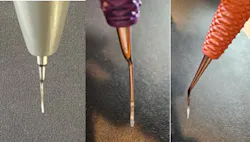
If your piezo scaling is loud, you are likely using the piezo like a magneto—by using the back of the tip. This will produce a loud, screeching sound. Concentrate on using only the lateral surfaces of the piezo tip (figure 1, left), like using the lateral sides of a universal curette (figure 1, middle) or sickle hand instrument (figure 1, right). You would never use the back of the hand instrument. You may need to say “use only the lateral sides of the piezo tip” in your head until it becomes second nature.
Using a decibel meter at Paschke Ultrasonix, sound levels were measured using the back of an EMS PL1 piezo tip against an extracted tooth at a calibrated force of 20 grams, resulting in an 82 dB level. Comparatively, 80 dB is equivalent to a blender. As you scale with piezo, listen for a change in pitch. A loud sound is an auditory cue that you are rolling onto the back of the piezo tip. Adjust to stay on the lateral surfaces for quieter piezo scaling.
Can thin inserts be used on any power level?
The power capability of any insert is based on many factors, not just its diameter. The tip material and how it is processed determine power limits more than just the tip diameter. For example, the tip diameter of the Dentsply Thinsert is 0.010 inches. The FSI-SLI-10S (Slimline) has a tip diameter of 0.020. Yet Dentsply rates its Thinsert power limit as high, but the Slimline as low to medium.1
Parkell DuraTip inserts have tip diameters ranging from 0.015 (Perio Slim) to 0.020 (Universal Slim), but both are rated to be used up to high power.2
Always follow the manufacturer’s recommendations.
I’ve been told a universal tip is all you need. Is that true?
As attachment loss increases, available root surfaces to instrument are more complex. Clinicians must memorize the root morphologies. Bone Box-Dental Pro is a great app to review root anatomy.
Paired, curved UITs should be used to adapt to more complex anatomy. Think of the curved rights and lefts like double-ended hand instruments. You wouldn’t only use one end of a double-ended hand instrument.
With proper sequencing, you can use one curved UIT in four quads on contralateral surfaces. For example, use the same UIT on the maxillary right buccal and the maxillary left lingual, as well as the mandibular left buccal and mandibular left lingual. Then switch to the other curved UIT.
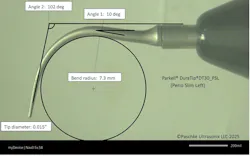
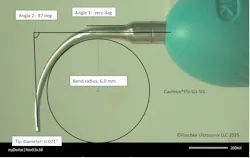
Not all curved UITs are created equal. Some right and left UITs have a more open terminal angle and therefore are less likely to gouge, have a contra-angle to enhance posterior access and adaptation, and can be used on any power setting, including high (figure 2). Others have a more closed terminal angle, no contra-angle, and according to the manufacturer’s recommendations should only be used up to medium power (figure 3).
Understanding instrument design is critical to discern the best UIT to match the clinical condition. Utilizing information from the Assessment phase of the ADHA Standards of Clinical Dental Hygiene Practice 20253 will determine the most effective UIT. One size or shape doesn’t fit all. Selecting the most appropriate UIT is part of our professional decision-making in providing personalized care for our clients.
Editor's note: This article appeared in the April/May 2026 print edition of RDH magazine. Dental hygienists in North America are eligible for a complimentary print subscription. Sign up here.
References
- Cavitron inserts. Clinical application guide. Dentsply Sirona. Accessed February 3, 2026. https://assets.dentsplysirona.com/websites/microsites/cavitron-world/inserts-clinical-application-guide.pdf
- Parkell DuraTip instructions for use. Parkell. Accessed February 3, 2026. https://www.parkell.com/SSP%20Applications/NetSuite%20Inc.%20-%20SCA%20Elbrus/Development/PDFs/IFUs/DuraTip-pslr-Insert-ifu.pdf
- ADHA Standards of Clinical Dental Hygiene Practice. American Dental Hygienists' Association. Revised 2025. https://www.adha.org/wp-content/uploads/2025/03/2025_Standards-of-Dental-Hygiene-Practice.pdf
About the Author
 Noel Slotke Paschke, MS, BSDH, RDH
Noel Slotke Paschke, MS, BSDH, RDH
Noel is an award-winning former faculty at the University of Maryland Dental School and has led three international companies’ education departments, including Dentsply Cavitron, Philips Sonicare, and Acteon. She offers consulting and educational services through her company Ultrasonics Plus. Contact her at [email protected].
Richard Paschke, MS, BS
Richard is a dental ultrasonic engineer, mentored by one of the founding physicists-inventors at Cavitron. After a 30-year career at Cavitron and subsequently Dentsply, Richard started Paschke Ultrasonix, where he provides engineering services to many dental companies.
Together they are known as Mr. and Mrs. Ultrasonics.