Beyond detection: How artificial intelligence is transforming clinical dental hygiene practice
Key Highlights
- AI can enhance radiographic interpretation and help hygienists identify periodontal changes more consistently.
- Visual AI tools can make complex findings easier for patients to understand, supporting codiagnosis and treatment acceptance.
- Voice-assisted charting and integrated AI can strengthen documentation, workflow efficiency, and longitudinal periodontal monitoring.

Every day, dental hygienists make hundreds of clinical decisions that influence patient outcomes—from recognizing subtle radiographic changes to determining appropriate periodontal therapy and educating patients about their oral health. As artificial intelligence (AI) becomes increasingly integrated into dental practice, it offers an opportunity to support these decisions through enhanced radiographic interpretation, improved documentation, and more meaningful patient communication.
For dental hygienists, AI is far more than a technology trend. It is an emerging clinical tool that can improve diagnostic consistency, streamline workflows, and support patient-centered care. By transforming complex clinical findings into clear, visual information, AI can facilitate codiagnosis, improve treatment acceptance, and reinforce evidence-based clinical decision-making.
While AI continues to evolve rapidly, its greatest value lies not in replacing clinical expertise, but in enhancing it. The dental hygienist remains responsible for interpreting findings within the context of the patient's clinical presentation, risk factors, and overall health. When thoughtfully integrated into practice, AI has the potential to elevate—not replace—the clinician's judgment while improving consistency across the dental team.
From detection to clinical decision-making
AI is changing the way clinicians interpret radiographs and identify periodontal disease. Advanced imaging platforms can detect subtle changes in crestal bone height, quantify radiographic bone loss, and compare findings over time with a level of consistency that may be difficult to achieve through visual interpretation alone. For dental hygienists, these technologies provide an additional layer of clinical information that supports earlier recognition of periodontal breakdown and more confident treatment planning.
However, AI should never be viewed as a substitute for comprehensive periodontal assessment. Radiographic findings represent only one component of diagnosis. Accurate classification still depends on clinical attachment level (CAL), probing depths, bleeding on probing, recession, furcation involvement, mobility, medical history, and an understanding of disease activity.1 AI can identify patterns and highlight areas of concern, but it cannot independently determine etiology, classify disease, or establish an individualized treatment plan.
The true strength of AI lies in supporting clinical reasoning. By combining enhanced radiographic interpretation with comprehensive periodontal assessment, dental hygienists can improve diagnostic consistency, facilitate earlier intervention, and provide patients with a clearer understanding of their periodontal health. Rather than replacing the clinician, AI serves as another piece of the diagnostic puzzle—one that helps translate data into more informed clinical decisions.2
Clinical pearl
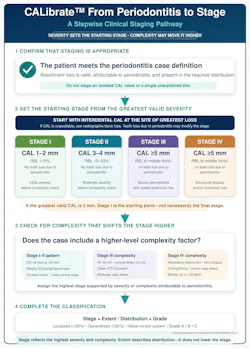
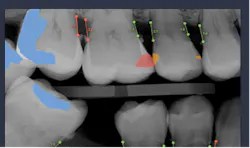
AI identifies findings. Dental hygienists integrate those findings with clinical evidence to make informed diagnostic and treatment decisions (figures 1 and 2).
Beyond detection ... to better patient conversations
AI does more than identify disease—it changes how clinicians communicate it. For decades, dental hygienists have relied on radiographs, periodontal charting, and intraoral photographs to explain disease progression and justify treatment recommendations. While these tools remain essential, many patients struggle to understand the relationship between what they see on an image and what it means for their long-term oral health.
AI bridges this communication gap by converting complex diagnostic information into clear, visual representations that are easier for patients to understand. Color overlays, highlighted areas of bone loss, and side-by-side comparisons of previous radiographs transform abstract findings into meaningful conversations. Rather than simply telling patients they have periodontal disease, clinicians can show them exactly where changes have occurred and how those findings support treatment recommendations.
This visual approach encourages codiagnosis, allowing patients to become active participants in their care rather than passive recipients of information. When patients better understand the relationship between biofilm, inflammation, attachment loss, and bone destruction, they are often more receptive to preventive recommendations and periodontal therapy.3 AI does not replace the clinician's ability to educate—it enhances the conversation by making clinical findings more tangible and easier to comprehend.
Ultimately, technology supports what dental hygienists have always done best: educate, motivate, and empower patients to make informed decisions about their oral health.
Clinical pearl
Patients are more likely to accept treatment when they understand what clinicians see (table 1).
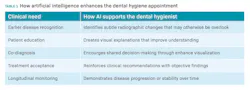
Artificial intelligence is most effective when integrated throughout the entire patient appointment—from assessment and education to treatment planning and long-term periodontal maintenance.
Beyond detection ... to stronger documentation and clinical consistency
Complete and accurate documentation remains one of the cornerstones of periodontal care. Yet studies continue to demonstrate significant variability in periodontal charting and documentation among clinicians, with less than 16% of periodontal charts recorded to completion. Incomplete records may affect diagnostic consistency, treatment planning, communication among providers, and insurance reimbursement.
AI, particularly when combined with voice-assisted periodontal charting and integrated practice management systems, offers an opportunity to improve both efficiency and consistency. Voice documentation captures probing depths, recession, bleeding on probing, furcation involvement, mobility, and other clinical findings. When bleeding on probing affects 30% or more of the mouth, it is consistent with generalized moderate gingivitis. Often, concerns regarding insurance coverage and reimbursement will limit the use of the preventive CDT code 4346 for scaling in the presence of generalized moderate to severe gingival inflammation.
More importantly, AI can aggregate information from multiple sources—including periodontal charting, radiographs, intraoral images, and previous examinations—to present clinicians with a comprehensive view of periodontal health. This longitudinal perspective helps identify trends that may not be immediately apparent during a single appointment, supporting earlier intervention and more informed clinical decision-making.4 Images with AI-assisted radiographic interpretation, along with comprehensive depiction of CAL and disease activity, will support early coverage for D4341 and D4342, nonsurgical scaling and root planing.
Improved documentation also benefits communication with insurance carriers. Thorough clinical records, supported by radiographic findings and objective measurements, strengthen documentation for appropriate coding and reimbursement when periodontal therapy is indicated.5 While AI does not determine treatment or coding, it can help ensure that the supporting clinical evidence is organized, complete, and readily accessible. This enables timelier intervention, preserving supportive structures, and improving long-term patient outcomes.
Perhaps the greatest benefit, however, is consistency. By reducing variability in documentation and highlighting findings that warrant further evaluation, AI supports more standardized clinical decision-making while preserving the dental hygienist's professional judgment.
Clinical pearl
Comprehensive documentation supports confident clinical decision-making. AI strengthens the process—but clinical judgment remains the responsibility of the dental hygienist.
Beyond detection ... to smarter AI implementation
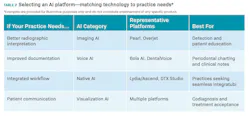
As AI becomes more widely adopted in dentistry, clinicians are faced with an increasing number of software options, each designed to address different aspects of patient care. Some AI platforms function as standalone applications that analyze radiographs or identify patterns of disease, while others are fully integrated into practice management and imaging systems, allowing clinicians to access AI-generated insights without disrupting their clinical workflow. Understanding these differences is essential when selecting technology that aligns with the goals and needs of the practice.
Rather than asking which AI platform is "best," dental hygienists should consider how the technology supports patient care, documentation, and communication. The most valuable systems are those that integrate seamlessly into existing workflows, improve efficiency without increasing administrative burden, and enhance—rather than replace—clinical decision-making. AI should simplify the clinician's day while strengthening the patient experience.
One of the fastest-growing applications is voice-assisted AI. Voice-enabled periodontal charting and clinical documentation allow clinicians to record periodontal findings, clinical notes, and treatment recommendations in real time while maintaining focus on the patient. By reducing manual data entry, these systems improve efficiency, enhance documentation, and allow more meaningful patient interactions during the appointment.
Other platforms focus on radiographic interpretation by highlighting potential areas of concern, quantifying bone levels, identifying restorative conditions, or comparing serial radiographs over time. Increasingly, integrated systems combine radiographic analysis, periodontal charting, intraoral imaging, and patient records to create a comprehensive clinical dashboard that supports longitudinal monitoring and evidence-based decision-making.5
Regardless of the platform selected, successful implementation depends on thoughtful integration into clinical practice. AI should complement existing diagnostic protocols, reinforce comprehensive periodontal assessment, and promote consistent communication among members of the dental team. The technology is most valuable when it serves as a clinical partner—helping dental hygienists organize information, recognize trends, and communicate findings more effectively while preserving professional judgment and individualized patient care.
Clinical pearl
The best AI platform is not necessarily the one with the most features—it is the one that integrates seamlessly into your workflow while enhancing clinical decision-making, patient communication, and documentation (table 2).
Clinical considerations
No single AI platform is ideal for every practice. The most successful implementations begin by identifying a practice's greatest clinical need and selecting technology that enhances existing workflows while supporting evidence-based patient care.
Editor's note: This article appeared in the November/December 2026 print edition of RDH magazine. Dental hygienists in North America are eligible for a complimentary print subscription. Sign up here.
References
- Papapanou PN, Sanz M, Buduneli N, et al. Periodontitis: consensus report of workgroup 2 of the 2017 World Workshop on the Classification of Periodontal and Peri-Implant Diseases and Conditions. J Clin Periodontol. 2018;45(Suppl. 20):S162-S170. doi:10.1111/jcpe.12946
- Strubchevska O, Kozyk M, Kozyk A, Strubchevska K. The role of artificial intelligence in diagnostic radiology. Cureus. 2024;16(10):e72173. doi:10.7759/cureus.72173
- Shah EB, Modi BB, Shah MA, Dave DH. Patient centered outcomes in periodontal treatment–an evidenced based approach. J Clin Diagn Res. 2017;11(4):ZE05-ZE07. doi:10.7860/JCDR/2017/24260.9631
- Fidyawati R, Masulili SLC, Iskandar HB, Suhartanto H, Kiswanjaya B, Li X. Clinical and radiographic parameters for early periodontitis diagnosis: a comparative study. Dent J (Basel). 2024;12(12):407. doi:10.3390/dj12120407
- Patil S, Joda T, Soffe B, et al. Efficacy of artificial intelligence in the detection of periodontal bone loss and classification of periodontal diseases: a systematic review. J Am Dent Assoc. 2023;154(9):795-804.e1. doi:10.1016/j.adaj.2023.05.010
About the Author
 Marianne Dryer, MEd, RDH
Marianne Dryer, MEd, RDH, is a dynamic speaker, educator, and consultant in curriculum development. She has lectured nationally and internationally on periodontal instrumentation with a focus on ultrasonic technique, risk assessment, infection prevention, and radiology technique. Her experience in dentistry spans more than 30 years. She is currently the Director of Dental Sciences at Cape Cod Community College. She is a graduate of Forsyth School for Dental Hygienists, Old Dominion University, and received her master’s in education from St.Joseph’s College of Maine. Contact her at [email protected] or through her website at mariannedryer.com.
 Andrea Fisher, MSML, RDH
Andrea Fisher, MSML, RDH, has been a clinical hygienist since 2013 when she graduated from Northern Arizona University. Passionate about clinical excellence, she has helped develop and lead a team of 20 providers in support of the state's leading board-certified periodontists at AZPerio. Driven to highlight the vital role dental hygienists play in practice success, she designs and delivers engaging education courses that emphasize leadership, codiagnosis, and patient-centered care.
Related
 Dental technology radiograph