How artificial intelligence is changing periodontal assessment: Enhancing diagnostic accuracy in dental hygiene practice
Key Highlights
- AI enhances periodontal assessments by identifying subtle bone loss, subgingival calculus, furcation involvement, and other radiographic findings that support earlier detection and treatment planning.
- Clinical judgment remains essential: AI complements—not replaces—the dental hygienist's expertise in diagnosis, patient education, risk assessment, and personalized care.
- Better patient understanding drives better outcomes: AI-enhanced imaging helps patients visualize periodontal disease, improving communication, treatment acceptance, and long-term maintenance.


Paradise Dental Technologies in partnership with RDH is expanding opportunities for dental hygiene students with its NEW Student Research Award Program. The following article is a recent research project submission.
Technology is woven into nearly every aspect of our daily lives, so why should dentistry be any different? As dental hygienists, we have the opportunity to embrace emerging technologies while supporting, not replacing, our clinical judgment and expertise. Artificial intelligence is one of the latest advancements reshaping dentistry, and periodontal assessment is an area where it has great potential.
Periodontal assessment is an essential part of what we do every day. It can be easy to overlook just how widespread and significant periodontal disease truly is. Nearly 40% of US adults, approximately 65 million people, are affected by some form of periodontal disease, making it one of the nation's most common chronic diseases and highlighting the importance of early detection.1
One of the greatest challenges we face is that many patients are unaware they have the disease. Helping patients understand the seriousness of a condition they cannot see or feel is one of the most difficult yet most important parts of periodontal care. Artificial intelligence offers another tool to support earlier detection, monitor progression, enhance patient education and understanding, and strengthen the periodontal care we provide every day.2
Why AI matters to today’s hygienists
Periodontal assessments have always required a combination of clinical examination, periodontal charting, and radiographic evaluation. While these techniques remain the foundation of periodontal assessment, they also rely heavily on the clinician. Differences in clinical judgment, experience level, and radiographic interpretation can sometimes lead to variability in assessment findings and treatment planning.²
Artificial intelligence offers an opportunity to support dental hygienists by providing another set of eyes and perspectives. By analyzing radiographs and comparing findings with large datasets, AI systems can recognize patterns associated with bone loss, periodontal disease severity, and changes over time.³
AI may also assist with identifying findings that can influence periodontal treatment planning, including areas of crestal bone loss, decay, furcation involvement, anatomical concerns, and potential subgingival calculus deposits.³ While these findings still require clinical confirmation, AI can help bring attention to areas that may indicate additional evaluation. This can be especially valuable during busy clinical days when subtle changes may be more difficult to recognize.
AI-supported periodontal assessments also benefit patients who experience challenges with traditional procedures. Patients with physical or cognitive limitations may have difficulty tolerating periodontal probing, remaining still during radiographs, or following assessment instructions, which can affect the accuracy of clinical findings. In these situations, AI may provide additional support by helping clinicians evaluate available information more consistently and identify areas that require further attention.4
Ways AI is improving periodontal assessments
- Identify areas of bone loss
- Support periodontal charting
- Improve treatment planning decisions
- Detect subgingival calculus
- Identify furcation involvement and anatomical risk factors
- Monitor disease progression
- Highlight areas of decay or other concerns
- Assist in risk assessment
AI in action: Case study
A 52-year-old man presents for a periodontal evaluation complaining that his gums bleed when he brushes. His medical history indicates type 2 diabetes. Clinical examination reveals generalized 4- to 5-mm probing depths with bleeding on probing. Bitewing and periapical radiographs demonstrate mild horizontal bone loss and areas of calculus (figures 1 and 2). After inputting the information, how can the AI enhanced radiograph assist in periodontal assessment?
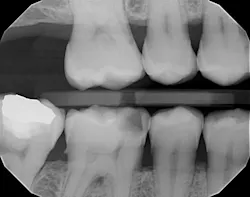
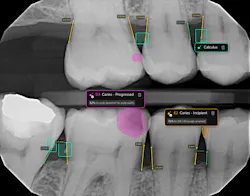
AI findings
The software identifies subtle posterior bone loss that was less apparent during the initial radiographic review. It also flags radiographic findings consistent with subgingival calculus, suggests possible furcation involvement on a mandibular molar, and highlights several interproximal areas that warrant evaluation for caries. Based on the combined radiographic findings, the software classifies the case as consistent with moderate periodontitis.
Clinical decision
- Diagnosis confirmed: Stage II periodontitis
- Initiated scaling and root planing
- Reinforced oral hygiene instruction
- Established three-month periodontal maintenance
By allowing the patient to visualize areas of bone loss and calculus, the discussion shifts from explaining the disease to demonstrating it.
What AI cannot do
The future of periodontal assessment isn't about artificial intelligence replacing dental hygienists. It's about giving us another tool to help us provide the best care possible to our patients. AI will never replace the knowledge, experience, and clinical judgment we bring to every appointment. Instead, it has the potential to support what we already do by helping identify findings, recognize patterns, and strengthen patient education.
Periodontal assessment is much more than measuring pocket depths or looking at radiographs. Every patient presents with a unique combination of clinical findings, medical history, risk factors, and individual needs. As dental hygienists, we bring all this information together to determine periodontal health, develop treatment recommendations, and educate patients about disease.2
Preparing for the future
AI cannot replace the qualities that define our profession. Critical thinking, compassion, communication, and the relationships we build with our patients remain at the heart of quality periodontal care. As technology continues to evolve, it is important to recognize our role isn't becoming less important. The future belongs to dental hygienists who are willing to embrace new technology while continuing to rely on the knowledge, experience, and patient-centered care that have always been the foundation of our profession.
Artificial intelligence does not diagnose periodontal disease … dental hygienists do. The heart of dental hygiene will always be the clinician behind the instruments. No technology will be able to replace the ability to assess, educate, and build trust and meaningful relationships with patients.4 What AI can do is serve as another clinical tool. It can help identify subtle radiographic findings that might otherwise be overlooked, improve consistency in interpreting images, monitor changes over time, and make it easier for patients to visualize and understand their periodontal disease.
As with any new technology, success relies on proper training, ethical consideration, thoughtful implementation, and being aware of its limitations. The future of periodontal care isn't about choosing between technology and clinical judgment; it's about using both together to provide the highest level of care for our patients.
Author’s note: This article was written with the assistance of artificial intelligence.
Editor’s note: This article first appeared in RDH eVillage newsletter, a publication of the Endeavor Business Media Dental Group. Read more articles and subscribe.
References
- About periodontal (gum) disease. Centers for Disease Control and Prevention. May 15, 2024. Accessed May 31, 2026. https://www.cdc.gov/oral-health/about/gum-periodontal-disease.html
- Patel MS, Kumar S, Patel B, et al. Impact of artificial intelligence on periodontology: a review. Cureus. 2025;17(3):e81162. doi:10.7759/cureus.81162
- Lee JE, Choi E, Park JB. Radiographic diagnosis of periodontitis using artificial intelligence: a meta-analysis comparing binary and staging classifications across imaging modalities. BMC Oral Health. 2025;25(1):1921. doi:10.1186/s12903-025-07171-z
- El-Hakim M, Anthonappa R, Fawzy A. Artificial intelligence in dental education: a scoping review of applications, challenges, and gaps. Dent J (Basel). 2025;13(9):384. doi:10.3390/dj13090384
About the Author
 Nicole M. Viterbo, BS, RDH
Nicole M. Viterbo, BS, RDH
Nicole M. Viterbo, BS, RDH, is a licensed dental hygienist with 20 years of clinical and office management experience. She is passionate about advancing the dental hygiene profession through education, mentorship, and supporting the growth of dental professionals. Nicole helped develop a dental student scholarship for her local community college. Her professional interests include team training, continuing education, and finding ways to improve patient care and the overall dental experience.