Decoding the language of clinical attachment: Evolving tools that are reshaping periodontal diagnosis and education
Key Highlights
- AI-enhanced radiographic interpretation is improving detection of early periodontal changes, helping clinicians distinguish subtle differences like clinical attachment loss vs. gingival inflammation.
- Accurate periodontal diagnosis depends on integrating CAL measurements, digital charting, and standardized protocols to reduce misclassification and improve patient outcomes.
- Dental education must prioritize AI integration and calibration training to ensure consistent, evidence-based periodontal assessment across clinicians.</
Editor's note: This is part three of a three-part series. Read part one. Read part two.
As dental hygiene advances into a new era of technology-driven practice, the role of radiographic interpretation and artificial intelligence (AI) is becoming central to improving diagnostic accuracy. While part two of this series explored the persistent confusion around staging, grading, and clinical attachment level (CAL)—including software limitations and the need for faculty calibration—part three shifts focus toward the evolving tools that are reshaping periodontal diagnosis and education. By examining how AI, digital charting, and enhanced calibration protocols intersect with evidence-based guidelines, we can better prepare hygienists to deliver standardized, accurate, and patient-centered periodontal care.
Radiographic interpretation and the role of AI in clarifying attachment loss and migration
AI is steadily transforming dental care by assisting clinicians in diagnosis, treatment planning, and record-keeping. In periodontics, AI plays an especially promising role in interpreting radiographs and helps to distinguish subtle differences between clinical presentations—such as clinical attachment loss versus apical migration. As periodontitis diagnosis becomes more structured under the 2017 AAP classification system, accurate and early detection of periodontal breakdown is essential. AI offers support in overcoming the inherent limitations of traditional radiographic evaluation, especially in early disease stages.1
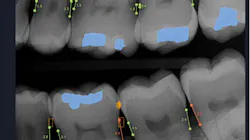
One of the greatest challenges in periodontal diagnosis lies in detecting early-stage periodontitis—specifically Stage 1—as it shares many clinical signs with gingivitis but involves initial bone loss. Radiographic interpretation of this early bone destruction is notoriously difficult. In fact, radiographic evidence of bone loss typically does not appear until at least 25% of the mineral content has been lost, making early-stage disease difficult or impossible to detect using conventional imaging alone.2 The minimal changes in bone density or contour may be obscured, especially in areas with overlapping anatomy. Gingivitis, on the other hand, presents with inflammation and bleeding but without the loss of bone or attachment. Misinterpreting subtle bone changes can result in underdiagnosis or misclassification, leading to missed opportunities for early intervention (figure 1).
Students in dental and/or dental hygiene programs should be introduced to emerging diagnostic tools such as AI to prepare them for the future of clinical practice. AI-driven technologies can support clinical decision-making by automating bone level analysis, identifying early signs of bone loss, and providing comparative data over time. These systems offer visual enhancements and precise, millimeter-based measurements that improve diagnostic clarity and standardization. Integrating AI into both educational and clinical settings can enhance the accuracy, confidence, and consistency with which students and practitioners apply the periodontal staging and grading system.3
Practical implications for clinical practice
Modern periodontal care, guided by evidence-based practices, requires more than just basic probing depth measurements, as it necessitates a comprehensive and precise evaluation of disease severity and progression. These distortions become especially problematic when clinicians attempt to stage or grade disease without calculating clinical attachment level (CAL), the most reliable marker of periodontal breakdown.4
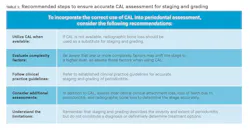
Table 1 provides recommended steps to ensure accurate CAL assessment for staging and grading appropriately.
Recommendations for dental and dental hygiene schools
Dental and dental hygiene schools must integrate rigorous calibration protocols into their curricula, emphasizing the precise identification of the CEJ and consistent probing techniques. Instructors and students should engage in periodic interexaminer calibration exercises to reduce diagnostic variability and build diagnostic confidence.
Dental and dental hygiene programs are essential in equipping students with the skills needed for accurate periodontal assessment.
Conclusion
The integration of AI-driven imaging, enhanced digital charting systems, and rigorous calibration protocols represents the next frontier for dental hygiene. By bridging the gap between traditional clinical assessment and advanced technology, hygienists can overcome longstanding diagnostic inconsistencies surrounding CAL, gingival margin recognition, and staging/grading applications. Ultimately, this article underscores that the future of periodontal care lies not only in precise measurement but also in embracing innovation. By preparing students and clinicians alike to use these tools with confidence, the profession can move closer to truly standardized, accurate, and outcomes-driven periodontal diagnosis and treatment.
Editor's note: This article appeared in the June 2026 print edition of RDH magazine. Dental hygienists in North America are eligible for a complimentary print subscription. Sign up here.
References
- Strubchevska O, Kozyk M, Kozyk A, Strubchevska K. The role of artificial intelligence in diagnostic radiology. Cureus. 2024;16(10):e72173. doi:10.7759/cureus.72173
- Fidyawati D, Masulili SLC, Iskandar HB, Suhartanto H, Kiswanjaya B, Li X. Clinical and radiographic parameters for early periodontitis diagnosis: a comparative study. Dent J (Basel). 2024;12(12):407. doi:10.3390/dj12120407
- Sweeting LA, Davis K, Cobb CM. Periodontal treatment protocol (PTP) for the general dental practice. J Dent Hyg. 2008;82(Suppl. 3):16-26.
- Shah EB, Modi BB, Shah MA, Dave DH. Patient centered outcomes in periodontal treatment–an evidenced based approach. J Clin Diagn Res. 2017;11(4):ZE05–ZE07. doi:10.7860/JCDR/2017/24260.9631
About the Author
 Marianne Dryer, MEd, RDH
Marianne Dryer, MEd, RDH
Marianne Dryer, MEd, RDH, is a dynamic speaker, educator, and consultant in curriculum development. She has lectured nationally and internationally on periodontal instrumentation with a focus on ultrasonic technique, risk assessment, infection prevention, and radiology technique. Her experience in dentistry spans more than 30 years. She is currently the Director of Dental Sciences at Cape Cod Community College. She is a graduate of Forsyth School for Dental Hygienists, Old Dominion University, and received her master’s in education from St.Joseph’s College of Maine. Contact her at [email protected] or through her website at mariannedryer.com.
 Katrina M. Sanders-Stewart, MEd, BSDH, RDH, RF
Katrina M. Sanders-Stewart, MEd, BSDH, RDH, RF
A clinical dental hygienist, author and international speaker, Katrina is passionate about elevating the dental profession by creating an undeniable movement that educates, encourages, and empowers the profession to rise in its power. Known as the “Dental WINEgenist™,” she pairs her desire for excellence in the dental industry with her knowledge and passion for wine. She is the Clinical Liaison for Hygiene Excellence at AZPerio, founder of Sanders Board Preparatory and has been published in various publications including RDH Magazine and Dental Academy of Continuing Dental Education. Recently, Katrina proudly received the University of Minnesota Distinguished Alumni Award and the 2024 Sunstar Award of Distinction. @TheDentalWINEgenist [email protected].