I turned down my first job in assisted hygiene. Now, 20 years later, I’d never practice any other way
Key Highlights
- Assisted hygiene can give hygienists more time for direct patient care while increasing efficiency and earning potential.
- A successful model depends on dedicated assistants, two operatories, efficient doctor exams, and appropriate financial incentives.
- After 20 years, one hygienist argues that assisted hygiene can support comprehensive care, patient relationships, and greater career autonomy.
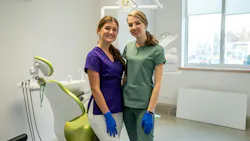
I understand why so many hygienists are skeptical of assisted hygiene. I was too. But after 20 years of practicing this way, I think much of what’s assumed about assisted hygiene misses what a well-designed model actually offers the hygienist.
When I graduated from hygiene school 20 years ago, I was offered a job practicing assisted hygiene. I turned it down. There was absolutely no way I wanted to work that way.
I became a hygienist because I wanted to provide excellent care and build relationships with patients. Assisted hygiene sounded like the opposite: a jam-packed schedule, running between rooms, and moving patients through as quickly as possible. I worried I'd sacrifice comprehensive care and patient rapport. Frankly, I worried I'd become a production machine.
A week after I declined the position, the dentist called me.
She asked what I didn't like about the offer and invited me to come back and talk about it. After discussing my concerns, I decided I was willing to give assisted hygiene a try.
Twenty years later, I wouldn't practice any other way.
I typically see 12–14 patients a day. And most importantly, I am incredibly proud of the level of care I provide my patients. I realize some hygienists will read “12–14 patients a day” and think, Absolutely not.
I get it! But before you decide assisted hygiene could never work for you, I want you to understand what those 12–14 appointments actually look like.
Related: Assisted hygiene: Why it works, and how it’s changed my work life
30 minutes isn't half of your 60-minute appointment
One of the most common objections about assisted hygiene is, “I don't have enough time to do everything I need in an hour. There is no way you could possibly provide comprehensive care in 30 minutes.”
But my 30-minute appointment isn't half of a traditional 60-minute appointment. Those 30 minutes are almost entirely direct RDH-level patient care.
I'm not routinely seating patients, taking radiographs, turning over operatories, processing instruments, polishing, flossing, or searching for someone to help with periodontal charting. And one of the biggest things I'm not doing is waiting for the dentist for a periodic exam.
I work with a dental assistant who is assigned to the hygiene department, and I work between two operatories. While the assistant is working with one patient, I’m working with another.
So, what am I doing during those 30 minutes?
I'm reviewing medical histories, completing periodontal assessments and charting, instrumentation, taking intraoral photos, and educating patients about their oral health. I'm discussing home care, TMD and orthodontic concerns, performing oral cancer screenings, and screening for signs and symptoms associated with sleep-disordered breathing. And I'm talking to my patients.
I'm still asking about their kids. I'm still hearing about their vacations. I'm still laughing with people I've treated for years. Frankly, it’s my favorite part of my job!
Assisted hygiene hasn't turned me into a robot. Rather, it’s allowed me to spend a greater percentage of my day doing the things I became a hygienist to do.
Comprehensive care and production are not competing goals
There can be discomfort in hygiene around the word production. Sometimes it's interpreted as putting money ahead of patients—or encouraging overtreatment.
Overtreatment is inappropriate. But undertreatment isn't quality patient care either.
Our responsibility is to evaluate the individual patient in front of us, identify their needs, educate them appropriately, and recommend care based on those needs. When we're providing truly comprehensive, individualized care, production naturally follows.
Having an understanding of the business of dentistry doesn't make us greedy, less ethical, or less committed to our patients.
Assisted hygiene has created a significant financial opportunity for me throughout my career. Because I'm paid on production, there is a meaningful difference between eight patients a day and 12–14. The practice benefits from the additional production I generate, and so do I.
What's in it for the hygienist?
For me, the benefits go far beyond compensation. In three clinical days, I see approximately the number of patients another hygienist might see in five, which means fewer days each week performing repetitive clinical work.
I also genuinely enjoy the pace. Assisted hygiene isn't for every hygienist—but neither is seeing one patient per hour. If you love traditional hygiene and have no desire to work between two operatories, don't! But for hygienists looking for greater earning potential, growth, or autonomy, I think assisted hygiene deserves serious consideration.
There’s a benefit for patients too. Because I can accommodate more patients each day, someone who cancels doesn't necessarily have to wait months to get back into my schedule. I can often see them within a week or two. For practices struggling with hygiene availability, that increased access to care is important.
Some hygienists hated assisted hygiene. I believe them.
I've surveyed hygienists who’ve practiced assisted hygiene and hated it. Interestingly, many described problems not with the concept itself, but with its implementation: poorly designed schedules, inadequately trained assistants, assistants constantly pulled from hygiene, and significantly more patients without additional financial incentive.
What makes assisted hygiene work well?
For assisted hygiene to work, several things are nonnegotiable. The hygienist needs two operatories. There needs to be an assistant assigned to the hygiene department—and they need to actually remain available to hygiene. The doctor has to be willing to adapt to an efficient exam workflow.
I also believe there should be a financial incentive for the hygienist. You're being asked to practice a completely different way than you have historically, and you're helping create added revenue for the practice. There should be an opportunity for you to benefit from that success as well.
Implementation is critical. If a hygienist's first experience with assisted hygiene is more patients, more stress, an unreliable assistant, and no financial upside, I can't blame them for never trying it again.
The relationship with the assistant also takes time to develop. After working with mine for nearly 18 years, our workflow is incredibly fluid, but it certainly didn't look that way on day one.
The dentist has to adapt too. It doesn't matter how efficiently the hygienist and assistant work if everything comes to a halt for the periodic exam. In my practice, once I've completed my assessment and discussed potential concerns, I move on to my next patient while my assistant remains with the patient for the doctor's exam.
Before you say no, time your next periodic exam
Before you dismiss assisted hygiene, start paying attention to where your hour actually goes.
Try timing your periodic exams. Start the clock from the moment you're ready for the doctor. Include the time spent notifying the doctor, waiting for them to arrive, and remaining in the operatory for the exam. Do it for every patient that day and add it up.
Ask yourself: How much of my day is spent waiting for or doing something that doesn't require my hygiene license? What else could I be doing with that time? Maybe you could treat another patient who’s been waiting months for an appointment. Maybe you could create greater flexibility—and earning potential—for yourself.
Or maybe you'll look at all of it and decide you have absolutely no interest in assisted hygiene. That's OK. I said I'd never do it either.
Twenty years later, assisted hygiene hasn't made me less of a hygienist. It hasn't taken away the patient relationships that matter so much to me. It hasn't forced me to sacrifice comprehensive care in the name of production.
For me, it’s created an incredibly rewarding career, greater financial opportunity and autonomy, while allowing me to provide a level of care that I'm proud of. After two decades, I still love being a hygienist.
I wouldn't want to practice any other way.
Note: Permitted duties for dental assistants vary by state. Practices should ensure all delegated duties comply with applicable state laws and scope-of-practice requirements.
Author’s note: This article was written with the assistance of artificial intelligence.
Editor’s note: This article first appeared in RDH eVillage newsletter, a publication of the Endeavor Business Media Dental Group. Read more articles and subscribe.
About the Author
 Courtney Wager, RDH
Courtney Wager, RDH, is the founder of Wager Practice Systems and has practiced assisted hygiene for more than 20 years. She helps dental practices rethink traditional hygiene workflows to improve patient care, practice economics, and opportunities for their hygiene teams. Learn more at wagerpracticesystems.com or follow Wager Practice Systems on Instagram and Facebook.
Related
 Dreamstime M 105829657
 Thinking