Teach me how to torque
Key Highlights
- The prevalence of dental implacts is continually growing, expected to be as high as 23% in 2026.
- Hygienists must be educated in implant maintenance and home-care protocols, as well as prosthesis removal, which is essential for collecting the baseline data needed to monitor patients' implants.
- Implants are highly manufacturer-specific, and selecting the correct screwdrivers and torque wrench inserts is critical to prevent loose or fractured screws.
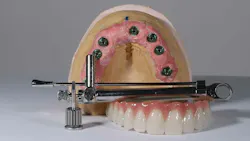
Dental hygienists use a lot of different instruments during a patient care appointment. We’ve spent hundreds of hours in school and beyond, perfecting our insertion and angulation techniques to effectively debride calculus and disrupt biofilm. However, most of us have never thought that a torque wrench would be a tool we might need to reach for when maintaining fixed full-arch implant bridges or hybrids. As an implant care specialist who has removed these prosthetics more than 11,000 times over the past decade, I’d like to share some insights and perspective for this role.
Hygienists’ role in implant dentistry
As implant dentistry expands, so does the need for hygienists who are trained to assess, monitor, and assist patients with maintaining their prosthetics. Our role to educate and customize home-care protocols is a vital skill to help our patients protect and preserve their investment. An initial comprehensive assessment with removal of the prosthesis is recommended to establish a baseline, ideally waiting until one year postload to allow for complete bone remodeling.1 Collecting baseline data is imperative to be able to detect changes or potential complications at future recare appointments. A dental hygiene diagnosis of health, perimucositis, or peri-implantitis will aid in determining the appropriate recare interval and should be revised as needed at each follow-up.2
Keep reading: Implant maintenance guide for early detection of peri-implant diseases
What to know before picking up a torque wrench
Clinicians must ensure the correct equipment is used, as implant parts and components are specific to the manufacturer. There are a variety of screwdrivers and torque wrench inserts to choose from. Hygienists must become proficient with safely using the correct tools to remove and reseat these prostheses if allowable by the practice act in their state. Understanding the distinction between “finger-tight” and “final torque” is vital, and following manufacturer-specific (Newton centimeter) settings can prevent screws from loosening or fracturing.
Once a hybrid arch is removed, the hygienist can assess the intaglio (underside) of the bridge for wear and biofilm accumulation. While removed, we assess the health of the implant through visual inspection of the surrounding gingiva, palpation, probing, and percussion. Debridement, when indicated, should be done with titanium scalers, ultrasonics, and glycine or erythritol powder air polishing.3 This is also the ideal time to ensure the internal abutment screws have not loosened. Radiographic images may also indicate osseointegration health, disease, or other concerns such as fractures. After cleaning, disinfecting, and reseating the prosthesis, the access holes are resealed with barrier materials. Oral hygiene instructions are customized to the patient’s needs and abilities, and the recare interval is established.
Demand is only growing
There is no central database that tracks the exact number of fixed full-arch implant bridge patients in the United States. However, dental implant prevalence is expected to be as high as 23% in 2026.4 Complete edentulism of at least one arch affects over 36 million Americans, and patients are shifting toward fixed solutions as an alternative to traditional dentures.5–7
Practitioners can no longer take a floss and polish approach for long-term maintenance or chairside protocols. The time is now for implementing comprehensive, evidence-based care for this growing segment of the population and elevating our professional skills to be confident providers and implant care specialists.
Continue the conversation: Rethinking implant maintenance on A Tale of Two Hygienists podcast
Editor's note
This article appeared in the July 2026 print edition of RDHmagazine. Dental hygienists in North America are eligible for a complimentary print subscription. Sign up here.
References
- Bauman GR, Mills M, Rapley J, et al. Clinical parameters of the evaluation during implant maintenance. Int J Oral Maxillofac Implants. 1992;7:220-227.
- Berglundh T, Armitage G, Araujo MG, et al. Peri-implant diseases and conditions: Consensus report of workgroup 4 of the 2017 World Workshop on the Classification of Periodontal and Peri-Implant Diseases and Conditions. J Periodontol. 2018;89(suppl 1):S313-S318. doi:10.1002/JPER.17-0739
- Wingrove SS. Peri-Implant Therapy for the Dental Hygienist. 2nd ed. Wiley-Blackwell; 2022.
- Elani HW, Starr JR, Da Silva JD, Gallucci GO. Trends in dental implant use in the U.S., 1999-2016, and projections to 2026. J Dent Res. 2018;97(13):1424-1430. doi:10.1177/0022034518792567
- Facts & Figures. American College of Prosthodontists. Accessed April 24, 2026. https://www.gotoapro.org/facts-figures/
- Kolen D. The latest in dentures. Ontario Academy of General Dentistry. Accessed April 24, 2026. https://www.agd.org/constituent/news/2022/09/12/the-latest-in-dentures#:~:text=2,3
- Oral Health Surveillance Report. CDC. https://www.cdc.gov/oral-health/media/pdfs/2024/10/CS351478-D_OralHealthSurvReprt-28Pgs-91824_Print_FINAL.pdf
Red flag checklist
- Mechanical: Any "shimmer" or movement of the bridge; persistent screw loosening; missing or fractured screw heads
- Biological: Presence of suppuration (pus); spontaneous bleeding on probing; radiographic bone loss (saucer-shaped); or a dull “thud” sound upon percussion
|
Recommended home-care tools |
||||||||||
|
Communication and documentation
|
Annual wellness check script |
|
Mrs. Jones, today I am recommending we remove your bridge for an annual assessment. Because implants don't have nerves, you won't “feel” an infection starting until it's very advanced. Removing the bridge allows me to see 360 degrees around the implants, verify that every screw is still tight, and deep-clean the areas you can't reach at home. It’s an “oil change” for your smile to ensure this investment lasts a lifetime. |
|
EMR clinical note template |
|
|
|
|
|
|
|
About the Author
 Alison Stahl, BS, RDH
Alison Stahl, BS, RDH
Alison Stahl, BS, RDH, has 23 years of dental industry experience, including 10 years specializing in implantology and more than 11,000 fixed full-arch prosthesis removals. A certified speaker, hygiene educator, and founder of Precision Peri-Implant Academy, she leads hands-on workshops that help dental teams build evidence-based protocols and clinical confidence in implant maintenance. Contact her at [email protected] for training, speaking engagements, or master class workshops.